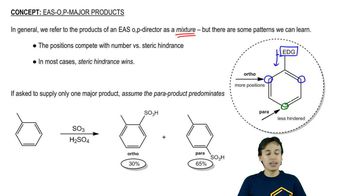
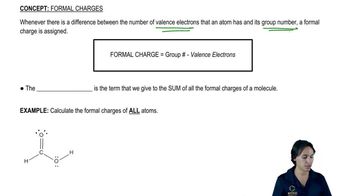
For each of the following compounds, draw the important resonance forms. Indicate which structures are major and minor contributors or whether they have the same energy. (d) [H2CNO2]–
Verified step by step guidance
1
Identify the structure of the nitromethane anion, \([\text{H}_2\text{CNO}_2]^−\). The central carbon atom is bonded to two hydrogen atoms and a nitro group \((\text{NO}_2)\). The nitro group is bonded to the carbon atom through a nitrogen atom.
Recognize that resonance forms involve the movement of electrons, typically through pi bonds or lone pairs. In \([\text{H}_2\text{CNO}_2]^−\), the nitro group \((\text{NO}_2)\) can exhibit resonance due to the presence of lone pairs on the oxygen atoms and the pi bond between nitrogen and oxygen.
Draw the first resonance structure: The negative charge is localized on one of the oxygen atoms, with a double bond between the nitrogen and the other oxygen atom. This is a common resonance form for nitro groups.
Draw the second resonance structure: Move the negative charge to the nitrogen atom, forming a double bond between the nitrogen and the carbon atom. This results in a single bond between nitrogen and one of the oxygen atoms, and a double bond with the other oxygen atom.
Evaluate the resonance forms: The resonance form with the negative charge on the oxygen is typically the major contributor due to oxygen's higher electronegativity compared to nitrogen. The resonance form with the negative charge on nitrogen is a minor contributor. Both forms contribute to the overall resonance hybrid, but the form with the negative charge on oxygen is more stable.
Verified video answer for a similar problem:
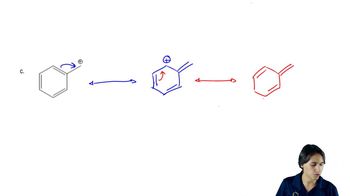
This video solution was recommended by our tutors as helpful for the problem above
Video duration:
6m
Play a video:
Was this helpful?
Key Concepts
Here are the essential concepts you must grasp in order to answer the question correctly.
Resonance Structures
Resonance structures are different Lewis structures for a molecule that depict the same arrangement of atoms but differ in the distribution of electrons. They are used to represent delocalized electrons within certain molecules where a single Lewis structure is insufficient. The true structure is a hybrid of all possible resonance forms, contributing to the molecule's stability.
In resonance, not all structures contribute equally to the resonance hybrid. Major contributors are those with the lowest energy, typically having full octets on atoms, minimal formal charges, and negative charges on more electronegative atoms. Minor contributors have higher energy due to incomplete octets, higher formal charges, or less favorable charge distributions.
Formal charge is a bookkeeping tool used to determine the charge distribution within a molecule. It is calculated by subtracting the number of electrons assigned to an atom in a Lewis structure from the number of valence electrons in the free atom. Structures with formal charges closer to zero are generally more stable and are often major contributors in resonance.