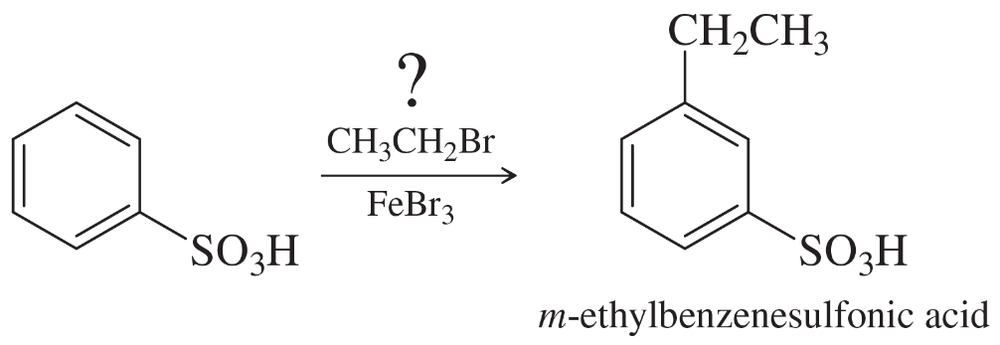
To synthesize m-ethylbenzenesulfonic acid, a student attempted the Friedel–Crafts alkylation of benzenesulfonic acid with bromoethane. Do you predict that this reaction was successful? If not, propose an alternative synthesis.
Verified step by step guidance
1
Step 1: Understand the Friedel–Crafts alkylation reaction. This reaction involves the introduction of an alkyl group onto an aromatic ring using an alkyl halide and a Lewis acid catalyst, such as AlCl₃. However, it is important to note that Friedel–Crafts alkylation does not work well with strongly deactivating groups on the aromatic ring.
Step 2: Analyze the structure of benzenesulfonic acid. The sulfonic acid group (-SO₃H) is a strongly electron-withdrawing group, which deactivates the benzene ring toward electrophilic substitution reactions, including Friedel–Crafts alkylation. This means the reaction with bromoethane is unlikely to be successful.
Step 3: Propose an alternative synthesis. To synthesize m-ethylbenzenesulfonic acid, you can first perform a Friedel–Crafts alkylation on benzene to introduce the ethyl group, forming ethylbenzene. This step avoids the deactivating effect of the sulfonic acid group.
Step 4: After forming ethylbenzene, perform sulfonation using concentrated sulfuric acid (H₂SO₄) or fuming sulfuric acid. Sulfonation introduces the sulfonic acid group (-SO₃H) onto the aromatic ring, and the reaction typically favors the meta position relative to the ethyl group due to steric and electronic effects.
Step 5: Verify the product. The final product, m-ethylbenzenesulfonic acid, can be confirmed using techniques such as NMR spectroscopy or IR spectroscopy to ensure the correct substitution pattern and functional groups are present.
Verified video answer for a similar problem:
This video solution was recommended by our tutors as helpful for the problem above
Video duration:
12m
Play a video:
Was this helpful?
Key Concepts
Here are the essential concepts you must grasp in order to answer the question correctly.
Friedel–Crafts Alkylation
Friedel–Crafts alkylation is a key reaction in organic chemistry that involves the introduction of an alkyl group into an aromatic ring using a Lewis acid catalyst. This reaction typically requires a strong electrophile and can lead to polysubstitution or rearrangement of the alkyl group, which may complicate the desired product formation. The presence of electron-withdrawing groups, such as sulfonic acid, can deactivate the aromatic ring, making it less reactive towards alkylation.
Electron-withdrawing groups (EWGs) are substituents that pull electron density away from the aromatic ring, decreasing its nucleophilicity and reactivity in electrophilic aromatic substitution reactions. In the case of benzenesulfonic acid, the sulfonic acid group (-SO3H) is a strong EWG, which significantly reduces the ring's ability to undergo Friedel–Crafts alkylation. This makes the alkylation of benzenesulfonic acid with bromoethane unlikely to succeed.
When a direct synthesis route is hindered, alternative strategies must be considered. For synthesizing m-ethylbenzenesulfonic acid, one could first perform a Friedel–Crafts acylation to introduce an acyl group, followed by a reduction to form the desired alkyl group. This two-step process can help bypass the limitations imposed by the sulfonic acid group, allowing for successful synthesis of the target compound.