In Section 23.7.4, we learned that Friedel–Crafts alkylation suffers from overalkylation. (a) Draw the product of a Friedel–Crafts reaction that resulted in three methyl groups adding to the ring. (b) Why is hard to stop at the addition of one alkyl group?
Verified step by step guidance
1
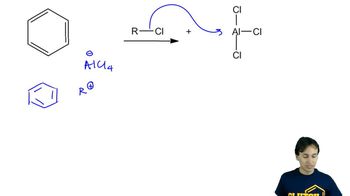
Step 1: Understand the Friedel-Crafts alkylation mechanism. This reaction involves the addition of alkyl groups to an aromatic ring using an alkyl halide and a Lewis acid catalyst, such as AlCl3.
Step 2: Recognize the role of the catalyst, AlCl3, which helps generate a carbocation from the alkyl halide (CH3Cl). The carbocation is the electrophile that will attack the aromatic ring.
Step 3: Consider the first alkylation step where the carbocation attacks the benzene ring, forming a new C-C bond and resulting in the addition of a methyl group to the ring.
Step 4: Understand why overalkylation occurs. The addition of the first methyl group increases the electron density of the ring, making it more reactive towards further electrophilic attack, leading to the addition of more methyl groups.
Step 5: Draw the final product with three methyl groups added to the benzene ring. The positions of the methyl groups can be ortho, meta, or para, but typically para and ortho positions are favored due to steric and electronic effects.
Verified video answer for a similar problem:
This video solution was recommended by our tutors as helpful for the problem above
Video duration:
7m
Play a video:
Was this helpful?
Key Concepts
Here are the essential concepts you must grasp in order to answer the question correctly.
Friedel–Crafts Alkylation
Friedel–Crafts alkylation is an electrophilic aromatic substitution reaction where an alkyl group is introduced to an aromatic ring using an alkyl halide and a Lewis acid catalyst. This reaction allows for the formation of new carbon-carbon bonds, enhancing the complexity of aromatic compounds. However, it often leads to multiple alkylation events, resulting in overalkylation.
Overalkylation refers to the phenomenon where multiple alkyl groups are added to an aromatic ring during a Friedel–Crafts reaction, rather than just one. This occurs because the alkylated aromatic compound can still act as a nucleophile, making it susceptible to further electrophilic attack. The stability of the resulting carbocation intermediates also contributes to this tendency.
Carbocation Stability
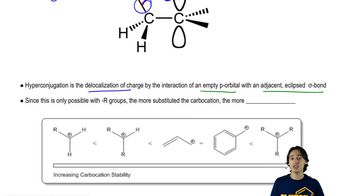
Carbocation stability is a key factor in determining the reactivity of intermediates in organic reactions. In Friedel–Crafts alkylation, the formation of a stable carbocation from the alkyl halide is crucial for the reaction to proceed. More substituted carbocations are generally more stable, which can lead to increased reactivity and the likelihood of multiple alkylation events occurring.