Predict the products formed when cyclohexanecarbaldehyde reacts with the following reagents. (d) excess ethanol and acid
Verified step by step guidance
1
Step 1: Recognize the functional group in cyclohexanecarbaldehyde. The molecule contains an aldehyde group (-CHO) attached to a cyclohexane ring. Aldehydes are reactive and can undergo nucleophilic addition reactions.
Step 2: Understand the role of the reagents. Ethanol (CH₃CH₂OH) is an alcohol, and the presence of acid (commonly H⁺) acts as a catalyst to facilitate the reaction. Together, these reagents suggest an acetal formation reaction.
Step 3: Recall the mechanism of acetal formation. In the presence of excess alcohol and acid, aldehydes react to form acetals. The reaction proceeds through the following steps: (a) protonation of the aldehyde oxygen to make the carbonyl carbon more electrophilic, (b) nucleophilic attack by ethanol on the carbonyl carbon, (c) formation of a hemiacetal intermediate, (d) protonation and loss of water to form a carbocation, and (e) a second nucleophilic attack by ethanol to form the acetal.
Step 4: Predict the structure of the acetal product. The aldehyde group (-CHO) in cyclohexanecarbaldehyde will react with two molecules of ethanol to form a diethoxy acetal. The final product will have two ethoxy groups (-OCH₂CH₃) attached to the former carbonyl carbon.
Step 5: Verify the reaction conditions. Ensure that the reaction is carried out under acidic conditions and with excess ethanol to drive the equilibrium toward acetal formation. This ensures the aldehyde is fully converted into the acetal product.
Verified video answer for a similar problem:
This video solution was recommended by our tutors as helpful for the problem above
Video duration:
2m
Play a video:
0 Comments
Key Concepts
Here are the essential concepts you must grasp in order to answer the question correctly.
Nucleophilic Addition
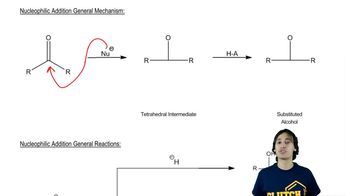
Nucleophilic addition is a fundamental reaction mechanism in organic chemistry where a nucleophile attacks an electrophilic carbon atom, typically found in carbonyl compounds like aldehydes. In the case of cyclohexanecarbaldehyde, the carbonyl carbon is susceptible to attack by nucleophiles such as ethanol, leading to the formation of an alkoxide intermediate.
Acetal formation occurs when an aldehyde reacts with an alcohol in the presence of an acid catalyst. This reaction involves the nucleophilic attack of the alcohol on the carbonyl carbon, followed by protonation and subsequent elimination of water, resulting in the formation of an acetal. In this scenario, excess ethanol and acid will drive the reaction towards acetal production.
Many organic reactions, including acetal formation, are reversible. The equilibrium between reactants and products can be influenced by factors such as concentration and temperature. In the presence of excess ethanol, the reaction favors the formation of the acetal, but under different conditions, the acetal can revert back to the aldehyde and alcohol, highlighting the dynamic nature of these chemical processes.


 2:48 minutes
 Verified step by step guidance
 08:27
08:27