

Alcohols combine with ketones and aldehydes to form interesting derivatives, which we will discuss in Chapter 18. The following reactions show the hydrolysis of two such derivatives. Propose mechanisms for these reactions. (a)
Verified step by step guidance
1
Identify the functional groups involved in the reaction. In this case, you have an alcohol and a ketone or aldehyde derivative. Understanding these groups will help you predict the types of reactions they undergo.
Recognize that the reaction involves hydrolysis, which typically means breaking a bond using water. Determine which bond in the derivative is likely to be cleaved during the hydrolysis process.
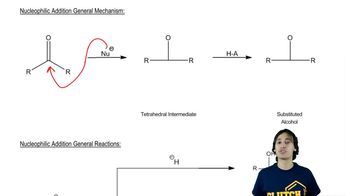
Consider the mechanism of hydrolysis. Generally, this involves nucleophilic attack by water or hydroxide ion on the electrophilic carbon of the carbonyl group, leading to the formation of a tetrahedral intermediate.
Analyze the stability of the tetrahedral intermediate. This intermediate will eventually collapse, leading to the formation of the alcohol and the carbonyl compound. Consider any proton transfers that may be necessary to stabilize the intermediate or the final products.
Outline the complete mechanism, showing each step of the nucleophilic attack, formation of the intermediate, and the final collapse to yield the alcohol and carbonyl compound. Use curved arrows to indicate the movement of electrons throughout the process.
Verified video answer for a similar problem:
This video solution was recommended by our tutors as helpful for the problem above
Video duration:
5m
Play a video:
Was this helpful?
Key Concepts
Here are the essential concepts you must grasp in order to answer the question correctly.
Nucleophilic Addition
Nucleophilic addition is a fundamental reaction mechanism in organic chemistry where a nucleophile attacks an electrophilic carbon atom, typically found in carbonyl groups of aldehydes and ketones. This process leads to the formation of a tetrahedral intermediate, which can further undergo protonation or elimination to yield alcohols or other derivatives. Understanding this mechanism is crucial for analyzing reactions involving alcohols and carbonyl compounds.
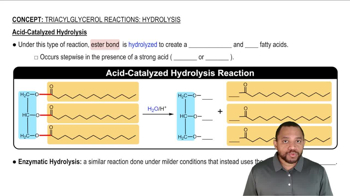
Hydrolysis reactions involve the breaking of chemical bonds through the reaction with water, resulting in the formation of new products. In the context of alcohols and carbonyl compounds, hydrolysis can convert derivatives back into their original forms or into different functional groups. Recognizing the conditions and products of hydrolysis is essential for proposing accurate reaction mechanisms.
A reaction mechanism is a detailed step-by-step description of the process by which reactants are converted into products. It outlines the sequence of bond-breaking and bond-forming events, including intermediates and transition states. Proposing a mechanism for the hydrolysis of alcohol-derivative reactions requires a solid understanding of the involved species and their interactions, which is critical for predicting the outcome of the reaction.