a. Use the polygon rule to draw an energy diagram (as in Figures 16-5 and 16-7) for the MOs of a planar cyclooctatetraenyl system. b. Fill in the eight pi electrons for cyclooctatetraene. Is this electronic configuration aromatic or antiaromatic? Could the cyclooctatetraene system be aromatic if it gained or lost electrons?
Verified step by step guidance
1
Step 1: The polygon rule states that the molecular orbital (MO) energy levels of a cyclic conjugated system can be derived by inscribing the polygon representing the molecule into a circle. The vertices of the polygon correspond to the energy levels of the MOs. For cyclooctatetraene, which is an 8-membered ring, draw an octagon inside a circle with one vertex pointing downward.
Step 2: Label the energy levels of the molecular orbitals. The lowest energy level corresponds to the vertex at the bottom of the circle, and the energy levels increase as you move upward. The degenerate energy levels are represented by pairs of vertices at the same height. Cyclooctatetraene will have 4 bonding MOs and 4 antibonding MOs.
Step 3: Fill in the eight π electrons into the molecular orbitals starting from the lowest energy level. Each orbital can hold a maximum of two electrons. For cyclooctatetraene, the electrons will fill the bonding orbitals first, and then the higher energy non-bonding or antibonding orbitals.
Step 4: Determine whether the electronic configuration is aromatic or antiaromatic. Aromatic systems follow Hückel's rule, which states that a planar cyclic conjugated system is aromatic if it has (4n + 2) π electrons, where n is an integer. Cyclooctatetraene has 8 π electrons, which does not satisfy Hückel's rule. Instead, it satisfies the condition for antiaromaticity (4n π electrons).
Step 5: Consider whether cyclooctatetraene could become aromatic by gaining or losing electrons. If the system gains 2 electrons (making it 10 π electrons) or loses 2 electrons (making it 6 π electrons), it would satisfy Hückel's rule and become aromatic. However, this would require a change in the electronic configuration of the molecule.
Verified video answer for a similar problem:
This video solution was recommended by our tutors as helpful for the problem above
Video duration:
2m
Play a video:
Was this helpful?
Key Concepts
Here are the essential concepts you must grasp in order to answer the question correctly.
Molecular Orbital Theory
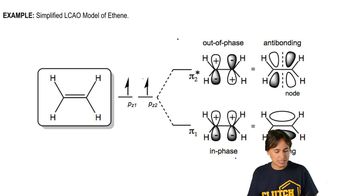
Molecular Orbital (MO) Theory describes the behavior of electrons in molecules by combining atomic orbitals to form molecular orbitals. These MOs can be bonding, antibonding, or non-bonding, and they help predict the stability and reactivity of molecules. In the case of cyclooctatetraene, the arrangement and filling of these MOs are crucial for understanding its electronic structure and properties.
Aromaticity refers to the enhanced stability of cyclic compounds with a planar structure and a continuous overlap of p-orbitals, allowing for delocalized pi electrons. In contrast, antiaromatic compounds, which also have a cyclic structure but contain 4n pi electrons (where n is an integer), are destabilized. Cyclooctatetraene, with 8 pi electrons, is antiaromatic due to its electron count and structure.
The electron configuration in molecular orbitals involves filling the available MOs according to the Aufbau principle, Pauli exclusion principle, and Hund's rule. For cyclooctatetraene, the filling of its 8 pi electrons into the MOs determines its electronic state. Understanding how these electrons are distributed helps in assessing whether the compound can achieve aromaticity by gaining or losing electrons.