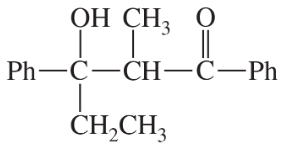
Show how each compound can be dissected into reagents joined by an aldol condensation, then decide whether the necessary aldol condensation is feasible. (b)
Verified step by step guidance
1
Step 1: Analyze the given compound structure. The compound contains a β-hydroxy ketone functional group, which is characteristic of an aldol addition product. This suggests that the compound was formed via an aldol condensation reaction.
Step 2: Identify the two fragments that could have combined during the aldol condensation. The β-hydroxy ketone structure indicates that one fragment must be an aldehyde or ketone with an α-hydrogen, and the other fragment must also be an aldehyde or ketone.
Step 3: Break the compound at the β-hydroxy position to determine the two possible starting reagents. The hydroxyl group and the adjacent carbonyl group suggest that the compound can be dissected into two phenyl-substituted ketones or aldehydes.
Step 4: Verify the feasibility of the aldol condensation. Check if both fragments have α-hydrogens to enable enolate formation. In this case, both fragments (e.g., acetophenone derivatives) have α-hydrogens, making the aldol condensation feasible.
Step 5: Consider the stereochemistry and substitution pattern. The presence of the hydroxyl group and the methyl and ethyl substituents suggests that the reaction conditions favored the formation of this specific β-hydroxy ketone product. Ensure that the reaction mechanism aligns with the observed structure.
Verified video answer for a similar problem:
This video solution was recommended by our tutors as helpful for the problem above
Video duration:
3m
Play a video:
Was this helpful?
Key Concepts
Here are the essential concepts you must grasp in order to answer the question correctly.
Aldol Condensation
Aldol condensation is a reaction between aldehydes or ketones that contain alpha-hydrogens, leading to the formation of β-hydroxy aldehydes or ketones. This reaction involves the nucleophilic addition of an enolate ion to a carbonyl compound, followed by dehydration to yield an α,β-unsaturated carbonyl compound. Understanding this process is crucial for dissecting compounds into their respective reagents.
Functional groups are specific groups of atoms within molecules that are responsible for the characteristic chemical reactions of those molecules. In the context of aldol condensation, hydroxyl (-OH) and carbonyl (C=O) groups are particularly important, as they dictate the reactivity and the pathways available for the reaction. Recognizing these groups in the given compounds is essential for determining the feasibility of the aldol condensation.
The feasibility of a chemical reaction refers to whether the reaction can occur under given conditions, often assessed through thermodynamic and kinetic considerations. In aldol condensation, factors such as the stability of the resulting product, steric hindrance, and the presence of suitable functional groups influence whether the reaction will proceed. Evaluating these aspects is key to determining if the aldol condensation is viable for the compounds in question.