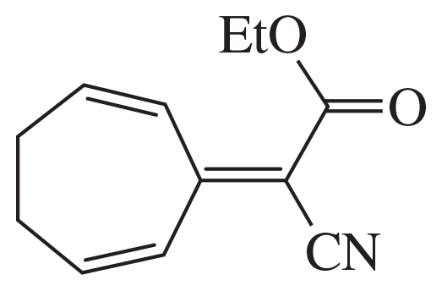
The Knoevenagel condensation is a special case of the aldol condensation in which an active methylene compound reacts with an aldehyde or ketone, in the presence of a secondary amine as a basic catalyst, to produce a new C=C. Show the starting materials that made each of these by a Knoevenagel condensation. (d)
Verified step by step guidance
1
Step 1: Identify the product structure. The given compound contains a conjugated system with a C=C bond adjacent to a cyano group (-CN) and an ester group (-COOEt). This suggests it was formed via a Knoevenagel condensation reaction.
Step 2: Recall the general mechanism of Knoevenagel condensation. It involves the reaction of an aldehyde or ketone with an active methylene compound (a compound with acidic hydrogens between two electron-withdrawing groups).
Step 3: Analyze the product to deduce the active methylene compound. The presence of the cyano group (-CN) and ester group (-COOEt) indicates that the active methylene compound is ethyl cyanoacetate (EtOOC-CH2-CN).
Step 4: Determine the aldehyde or ketone used in the reaction. The aromatic ring with a single substituent (the conjugated C=C bond) suggests that benzaldehyde (C6H5CHO) was the aldehyde used.
Step 5: Combine the components. The Knoevenagel condensation between benzaldehyde (C6H5CHO) and ethyl cyanoacetate (EtOOC-CH2-CN) in the presence of a secondary amine catalyst would yield the given product.
Verified video answer for a similar problem:
This video solution was recommended by our tutors as helpful for the problem above
Video duration:
4m
Play a video:
Was this helpful?
Key Concepts
Here are the essential concepts you must grasp in order to answer the question correctly.
Knoevenagel Condensation
The Knoevenagel condensation is a reaction where an active methylene compound reacts with an aldehyde or ketone in the presence of a basic catalyst, typically a secondary amine. This reaction results in the formation of a carbon-carbon double bond (C=C) and is characterized by the elimination of a small molecule, often water. It is a key reaction in organic synthesis for forming α,β-unsaturated carbonyl compounds.
Active methylene compounds are organic molecules that contain a methylene group (–CH2–) adjacent to a carbonyl group (C=O) or another electron-withdrawing group. This configuration makes the methylene hydrogen atoms particularly acidic, allowing them to be deprotonated to form a nucleophile that can attack electrophiles, such as aldehydes or ketones, in reactions like the Knoevenagel condensation.
Aldol condensation is a fundamental reaction in organic chemistry where aldehydes or ketones with α-hydrogens undergo a reaction to form β-hydroxy carbonyl compounds, which can further dehydrate to yield α,β-unsaturated carbonyl compounds. The Knoevenagel condensation can be viewed as a specific type of aldol condensation where the reaction involves an active methylene compound, highlighting the versatility of carbonyl chemistry in forming complex molecules.