a. Propose a mechanism for the following reaction:
Verified step by step guidance
1
Step 1: Identify the functional groups present in the reactants and the products. This will help you understand the type of reaction taking place, such as addition, elimination, substitution, or rearrangement.
Step 2: Determine the electron flow by identifying nucleophiles and electrophiles. Nucleophiles are electron-rich species that donate electrons, while electrophiles are electron-deficient species that accept electrons.
Step 3: Draw the first step of the mechanism, showing the attack of the nucleophile on the electrophile. Use curved arrows to indicate the movement of electrons from the nucleophile to the electrophile.
Step 4: Consider any intermediates that may form during the reaction. These are often carbocations, carbanions, or radicals, depending on the reaction conditions and the stability of the intermediates.
Step 5: Complete the mechanism by showing the final steps that lead to the formation of the product. Ensure that all atoms are accounted for and that the electron flow is consistent with the formation of the product.
Verified video answer for a similar problem:
This video solution was recommended by our tutors as helpful for the problem above
Video duration:
7m
Play a video:
0 Comments
Key Concepts
Here are the essential concepts you must grasp in order to answer the question correctly.
Reaction Mechanism
A reaction mechanism is a step-by-step description of how a chemical reaction occurs at the molecular level. It outlines the sequence of elementary steps, including bond breaking and formation, and the intermediates formed during the reaction. Understanding the mechanism helps predict the products and the conditions under which the reaction occurs.
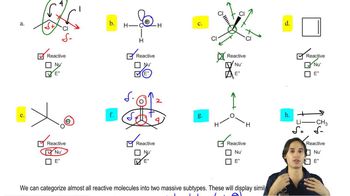
Nucleophiles are species that donate an electron pair to form a chemical bond, while electrophiles are species that accept an electron pair. In organic reactions, identifying the nucleophile and electrophile is crucial for proposing a mechanism, as it determines the direction of electron flow and the formation of products.
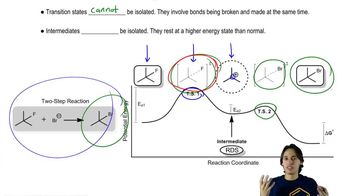
Transition states are high-energy states that occur during the transformation from reactants to products, representing the point of maximum energy along the reaction pathway. Intermediates are species that are formed and consumed during the reaction but are not present in the final products. Understanding these concepts is essential for accurately depicting the mechanism of a reaction.


 7:04 minutes
 Verified step by step guidance

 02:16
02:16