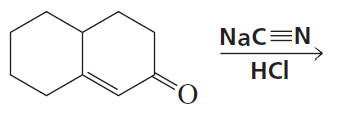
What is the major product of each of the following reactions? a.
Verified step by step guidance
1
Step 1: Analyze the structure of the starting material. The molecule is a cyclic ketone (cyclohexanone derivative) with a methyl group at the 2-position and a double bond at the 3-position.
Step 2: Identify the reagents. Potassium cyanide (KCN) in water is used, which suggests a nucleophilic addition reaction involving cyanide ion (CN⁻). Cyanide is a strong nucleophile.
Step 3: Determine the site of reactivity. The carbonyl group (C=O) is highly electrophilic due to the partial positive charge on the carbon atom. The cyanide ion will attack this carbon atom, leading to the formation of a cyanohydrin.
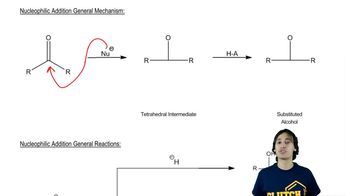
Step 4: Predict the mechanism. The cyanide ion attacks the carbonyl carbon, breaking the π bond of the C=O group. This results in the formation of a tetrahedral intermediate, which is stabilized by protonation from water to form the cyanohydrin.
Step 5: Consider stereochemistry. Since the starting material is cyclic and the reaction creates a new chiral center, the product may exist as a mixture of stereoisomers (enantiomers) depending on the orientation of the cyanide addition.
Verified video answer for a similar problem:
This video solution was recommended by our tutors as helpful for the problem above
Video duration:
2m
Play a video:
Was this helpful?
Key Concepts
Here are the essential concepts you must grasp in order to answer the question correctly.
Conjugate Addition
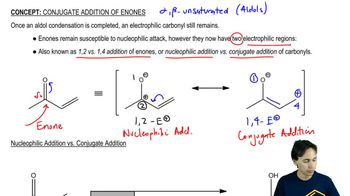
Conjugate addition refers to the nucleophilic addition of a reagent to an α,β-unsaturated carbonyl compound. In this reaction, the nucleophile attacks the β-carbon, leading to the formation of a new bond while the double bond shifts. This process is crucial in organic synthesis as it allows for the formation of more complex molecules from simpler ones.
Nucleophiles are species that donate an electron pair to form a chemical bond in a reaction. In the context of the given reaction, KCN acts as a nucleophile, where the cyanide ion (CN-) attacks the electrophilic carbon of the carbonyl group. Understanding the nature of nucleophiles is essential for predicting the outcome of organic reactions.
Hydrolysis is a chemical reaction involving the breaking of a bond in a molecule using water. In the context of the reaction shown, after the nucleophilic addition of KCN, hydrolysis occurs when water is used to convert the intermediate into a stable product, typically resulting in the formation of a hydroxyl group. This step is vital for completing the reaction and determining the final product.