Predict the major products formed when benzoyl chloride (PhCOCl) reacts with the following reagents. (d) anisole and aluminum chloride (e) excess phenylmagnesium bromide, then dilute acid (f) LiAlH(O-t-Bu)3
Verified step by step guidance
1
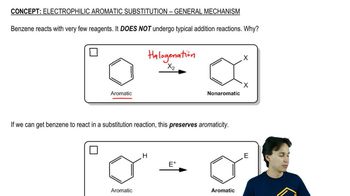
Step 1: For part (d), recognize that the reaction involves anisole (methoxybenzene) and aluminum chloride (AlCl₃). This is a Friedel-Crafts acylation reaction. Benzoyl chloride (PhCOCl) will react with AlCl₃ to form an acylium ion (PhCO⁺), which is the electrophile in this reaction. The methoxy group (-OCH₃) on anisole is an electron-donating group, activating the aromatic ring and directing the electrophile to the ortho and para positions.
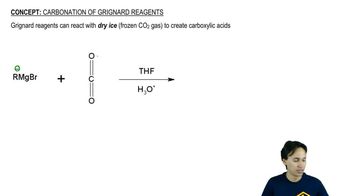
Step 2: For part (e), identify that the reaction involves excess phenylmagnesium bromide (a Grignard reagent) followed by dilute acid. The carbonyl group in benzoyl chloride (PhCOCl) is highly reactive toward nucleophiles. The Grignard reagent will attack the carbonyl carbon, forming a tetrahedral intermediate. Since excess Grignard reagent is present, a second equivalent will react with the intermediate to form a tertiary alcohol after acid workup.
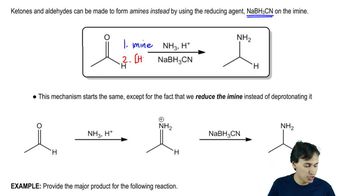
Step 3: For part (f), understand that LiAlH(O-t-Bu)₃ is a bulky reducing agent. It selectively reduces acid chlorides (like benzoyl chloride) to aldehydes without further reducing the aldehyde to an alcohol. The steric hindrance of the bulky tert-butoxy groups prevents over-reduction.
Step 4: For part (d), predict the major products by considering the regioselectivity of the Friedel-Crafts acylation. The acylium ion (PhCO⁺) will add to the ortho and para positions of anisole, but the para product is typically favored due to steric hindrance at the ortho position.
Step 5: For parts (e) and (f), confirm the products by analyzing the reaction mechanisms. In part (e), the final product is a tertiary alcohol formed after the Grignard reagent reacts twice with the carbonyl group. In part (f), the product is benzaldehyde, as the reduction stops at the aldehyde stage due to the bulky reducing agent.
Verified video answer for a similar problem:
This video solution was recommended by our tutors as helpful for the problem above
Video duration:
5m
Play a video:
Was this helpful?
Key Concepts
Here are the essential concepts you must grasp in order to answer the question correctly.
Electrophilic Aromatic Substitution
Electrophilic aromatic substitution (EAS) is a fundamental reaction in organic chemistry where an electrophile replaces a hydrogen atom on an aromatic ring. In the case of benzoyl chloride reacting with anisole in the presence of aluminum chloride, the electrophilic carbon of the benzoyl group can react with the nucleophilic aromatic ring of anisole, leading to the formation of a substituted product.
Grignard reagents, such as phenylmagnesium bromide, are highly reactive organomagnesium compounds that act as nucleophiles. When excess phenylmagnesium bromide reacts with benzoyl chloride, it can attack the carbonyl carbon, leading to the formation of a tertiary alcohol after subsequent acid workup. Understanding the reactivity of Grignard reagents is crucial for predicting the products of such reactions.
Reduction reactions involve the gain of electrons or the decrease in oxidation state of a molecule. In the context of the reaction with LiAlH(O-t-Bu)3, a selective reducing agent, the carbonyl group of benzoyl chloride is reduced to a corresponding alcohol. This concept is essential for understanding how different reducing agents can selectively convert functional groups in organic compounds.