1. Propose a mechanism for the acid-catalyzed reaction of salicylic acid with acetic anhydride. 2. Explain why a single drop of sulfuric acid dramatically increases the reaction rate.
Verified step by step guidance
1
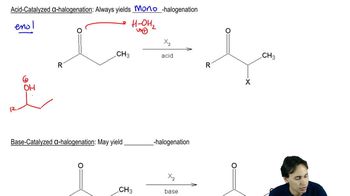
Step 1: Begin by identifying the functional groups involved in the reaction. Salicylic acid contains both a phenolic hydroxyl group (-OH) and a carboxylic acid group (-COOH). Acetic anhydride is a reactive compound with two acyl groups. The acid catalyst (sulfuric acid) will protonate key intermediates to facilitate the reaction.
Step 2: In the acid-catalyzed mechanism, sulfuric acid donates a proton (H⁺) to the carbonyl oxygen of acetic anhydride. This protonation increases the electrophilicity of the carbonyl carbon, making it more susceptible to nucleophilic attack. Represent this step using MathML:
Step 3: The phenolic hydroxyl group (-OH) of salicylic acid acts as a nucleophile and attacks the electrophilic carbonyl carbon of the protonated acetic anhydride. This forms a tetrahedral intermediate. Represent the nucleophilic attack using MathML:
Step 4: The tetrahedral intermediate undergoes proton transfer and elimination of acetic acid (CH₃COOH), regenerating the acid catalyst (H⁺). This step completes the formation of acetylsalicylic acid (aspirin). Represent the elimination step using MathML:
Step 5: Sulfuric acid dramatically increases the reaction rate because it acts as a strong acid, effectively protonating the acetic anhydride and stabilizing intermediates. This lowers the activation energy of the reaction, making the process faster and more efficient.
Verified video answer for a similar problem:
This video solution was recommended by our tutors as helpful for the problem above
Video duration:
13m
Play a video:
Was this helpful?
Key Concepts
Here are the essential concepts you must grasp in order to answer the question correctly.
Acid-Catalyzed Reactions
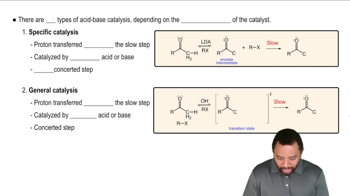
Acid-catalyzed reactions involve the use of an acid to increase the rate of a chemical reaction. In these reactions, the acid donates protons (H+) to the reactants, enhancing their electrophilicity and facilitating the formation of intermediates. This is particularly important in organic reactions where the presence of an acid can stabilize charged intermediates, making the overall process more efficient.
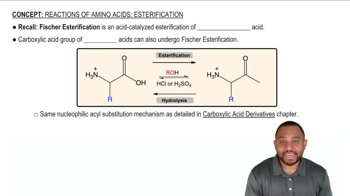
The mechanism of esterification describes how carboxylic acids react with alcohols or anhydrides to form esters. In the case of salicylic acid and acetic anhydride, the reaction involves the nucleophilic attack of the hydroxyl group of salicylic acid on the carbonyl carbon of acetic anhydride, leading to the formation of an ester bond and the release of acetic acid. Understanding this mechanism is crucial for predicting the products and reaction conditions.
Reactions of Amino Acids: Esterification Concept 1
Role of Sulfuric Acid as a Catalyst
Sulfuric acid acts as a strong acid catalyst that significantly increases the reaction rate by providing protons to the reaction mixture. This protonation enhances the electrophilic character of the acetic anhydride, making it more reactive towards nucleophilic attack. The presence of sulfuric acid also helps to remove water formed during the reaction, shifting the equilibrium towards product formation and thus accelerating the overall reaction.