
Sodium triacetoxyborohydride, NaBH(OAc)3, is a mild reducing agent that reduces aldehydes much more quickly than ketones. It can be used to reduce aldehydes in the presence of ketones, such as in the following reaction: (a) Draw a complete Lewis structure for sodium triacetoxyborohydride.
Verified step by step guidance
1
Identify the components of sodium triacetoxyborohydride, NaBH(OAc)3. It consists of a sodium ion (Na+), a boron atom (B), and three acetate groups (OAc).
Understand that the acetate group (OAc) is a shorthand for CH3COO-. Each acetate group is bonded to the boron atom through the oxygen atom.
Draw the boron atom at the center of the structure. Boron typically forms three covalent bonds and can accommodate an additional bond due to its empty p-orbital.
Attach each of the three acetate groups to the boron atom through the oxygen atom. Each oxygen atom in the acetate group will form a single bond with the boron atom.
Include the sodium ion (Na+) in the structure. It is typically not covalently bonded to the rest of the molecule but is present to balance the charge of the borohydride anion.
Verified video answer for a similar problem:
This video solution was recommended by our tutors as helpful for the problem above
Video duration:
5m
Play a video:
Was this helpful?
Key Concepts
Here are the essential concepts you must grasp in order to answer the question correctly.
Sodium Triacetoxyborohydride
Sodium triacetoxyborohydride, NaBH(OAc)3, is a selective reducing agent commonly used in organic synthesis. It is particularly effective at reducing aldehydes to alcohols while leaving ketones largely unaffected. This selectivity is due to its mild reducing power, which allows it to differentiate between the more reactive aldehyde carbonyl group and the less reactive ketone carbonyl group.
Reduction of aldehydes involves the conversion of the carbonyl group (C=O) into an alcohol group (C-OH). This process typically requires a reducing agent, such as sodium triacetoxyborohydride, which donates hydride ions (H-) to the carbonyl carbon, resulting in the formation of an alcohol. The reaction is crucial in organic chemistry for synthesizing alcohols from aldehydes.
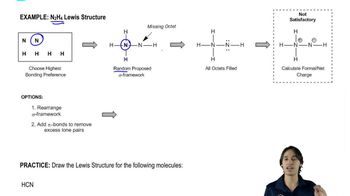
A Lewis structure is a diagrammatic representation of the valence electrons in a molecule, showing how atoms are bonded together. It includes symbols for the elements, lines for bonds, and dots for lone pairs of electrons. Drawing the Lewis structure for sodium triacetoxyborohydride involves representing the boron atom bonded to three acetate groups and a hydride ion, highlighting the electron distribution and molecular geometry.