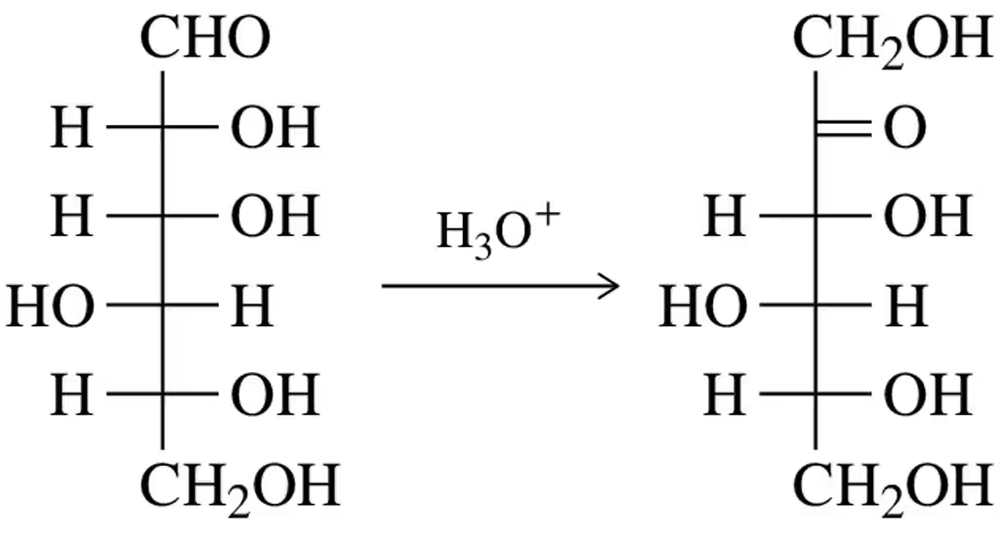
Ketohexoses form from aldohexoses. Suggest a mechanism for the acid-catalyzed version of this reaction. What type of reaction is this? [You’ve seen it before.]
Verified step by step guidance
1
Identify the starting aldohexose and the resulting ketohexose. The starting compound is an aldohexose with an aldehyde group at the top, and the product is a ketohexose with a ketone group on the second carbon.
Recognize that the reaction involves an isomerization process where the aldehyde group is converted into a ketone group. This is a type of tautomerization reaction known as an aldose-ketose isomerization.
In the presence of an acid catalyst (H3O+), the reaction begins with the protonation of the carbonyl oxygen of the aldehyde group, increasing its electrophilicity.
A hydride shift occurs where a hydrogen atom from the adjacent carbon (C2) migrates to the carbonyl carbon, forming a carbocation at C2. This step is crucial for the rearrangement of the carbonyl group.
Finally, deprotonation of the hydroxyl group at C2 leads to the formation of the ketone group, completing the conversion from an aldohexose to a ketohexose.
Verified video answer for a similar problem:
This video solution was recommended by our tutors as helpful for the problem above
Video duration:
3m
Play a video:
Was this helpful?
Key Concepts
Here are the essential concepts you must grasp in order to answer the question correctly.
Aldohexoses and Ketohexoses
Aldohexoses are six-carbon sugars with an aldehyde group, while ketohexoses contain a ketone group. The conversion from aldohexoses to ketohexoses involves the rearrangement of functional groups, specifically the migration of the carbonyl group from the end of the chain to the second carbon. This transformation is essential in carbohydrate chemistry and plays a significant role in metabolic pathways.
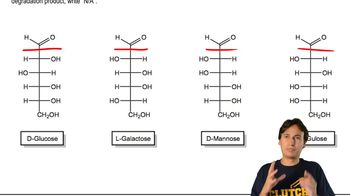
Which aldohexoses produce the same Wohl Degradation product
Acid-Catalyzed Mechanism
An acid-catalyzed mechanism involves the use of an acid to facilitate a chemical reaction, often by protonating a reactant to make it more electrophilic. In the case of converting aldohexoses to ketohexoses, the acid can protonate the hydroxyl group, leading to the formation of a more reactive intermediate. This mechanism typically involves steps such as protonation, rearrangement, and deprotonation.
A rearrangement reaction is a type of chemical reaction where the structure of a molecule is reorganized to form a new compound. In the context of converting aldohexoses to ketohexoses, this reaction involves the migration of the carbonyl group and the reorganization of the carbon skeleton. Such reactions are common in organic chemistry and are crucial for understanding carbohydrate transformations.