Draw the structure for each of the following: f. m-chlorostyrene
Verified step by step guidance
1
Identify the parent structure: The parent structure is 'styrene,' which consists of a benzene ring attached to an ethene group (C6H5-CH=CH2).
Understand the prefix 'm-chloro': The 'm-' (meta) position indicates that the chlorine atom is attached to the benzene ring at the position that is one carbon away from the ethene group, skipping the adjacent carbon (para and ortho positions are not used here).
Number the benzene ring: Assign the carbon attached to the ethene group as position 1. The meta position corresponds to position 3 on the benzene ring.
Add the chlorine substituent: Place a chlorine atom (Cl) at the meta position (position 3) of the benzene ring.
Draw the final structure: Combine the benzene ring with the ethene group at position 1 and the chlorine atom at position 3 to complete the structure of m-chlorostyrene.
Verified video answer for a similar problem:
This video solution was recommended by our tutors as helpful for the problem above
Video duration:
2m
Play a video:
Was this helpful?
Key Concepts
Here are the essential concepts you must grasp in order to answer the question correctly.
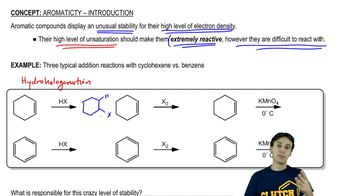
Aromatic Compounds
Aromatic compounds are a class of cyclic compounds that contain conjugated pi electron systems, which follow Huckel's rule (4n + 2 pi electrons). They are characterized by their stability and unique reactivity due to resonance. Understanding the structure of aromatic compounds is essential for drawing and predicting the behavior of compounds like m-chlorostyrene.
Substitution reactions in organic chemistry involve the replacement of one atom or group in a molecule with another. In the case of m-chlorostyrene, the chlorine atom is a substituent on the aromatic ring. Recognizing how substituents affect the reactivity and stability of aromatic compounds is crucial for accurately representing their structures.
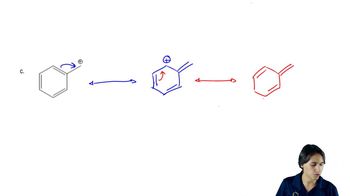
Styrene is an aromatic hydrocarbon with a vinyl group (–CH=CH2) attached to a benzene ring. The presence of the vinyl group influences the reactivity of the compound, particularly in polymerization reactions. Understanding the basic structure of styrene is vital for drawing derivatives like m-chlorostyrene, where a chlorine atom is positioned on the meta position relative to the vinyl group.