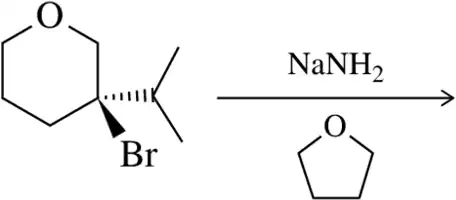
Given the reactants shown, what type of elimination would you expect to occur? (a)
Verified step by step guidance
1
Identify the reactants and analyze their structure. Look for key features such as the presence of a leaving group, the type of carbon it is attached to (primary, secondary, or tertiary), and any adjacent hydrogens that can be eliminated.
Determine the reaction conditions provided or implied. For example, strong bases like NaOH or KOH typically favor E2 elimination, while weaker bases or acidic conditions may favor E1 elimination.
Consider the steric hindrance around the leaving group. If the carbon attached to the leaving group is tertiary, E1 elimination is more likely due to the stability of the carbocation intermediate. If the carbon is primary or secondary, E2 elimination is more likely due to the direct one-step mechanism.
Examine the base used in the reaction. A bulky base (e.g., tert-butoxide) will favor elimination over substitution and may lead to the less substituted alkene (Hofmann product). A smaller base will favor the more substituted alkene (Zaitsev product).
Evaluate the solvent used in the reaction. Polar protic solvents tend to stabilize carbocations and favor E1 elimination, while polar aprotic solvents are better suited for E2 elimination.
Verified video answer for a similar problem:
This video solution was recommended by our tutors as helpful for the problem above
Video duration:
2m
Play a video:
Was this helpful?
Key Concepts
Here are the essential concepts you must grasp in order to answer the question correctly.
Elimination Reactions
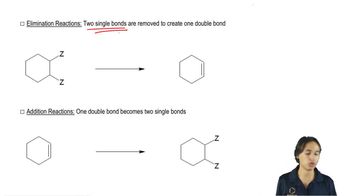
Elimination reactions are a class of organic reactions where two substituents are removed from a molecule, resulting in the formation of a double bond or a ring structure. These reactions are typically classified into two main types: E1 and E2, which differ in their mechanisms and the conditions under which they occur. Understanding the type of elimination is crucial for predicting the products formed during the reaction.
The E1 mechanism involves a two-step process where the leaving group departs first, forming a carbocation intermediate, followed by deprotonation to form the double bond. In contrast, the E2 mechanism is a one-step process where the base abstracts a proton while the leaving group exits simultaneously. The choice between E1 and E2 depends on factors such as substrate structure, the strength of the base, and the reaction conditions.
Zaitsev's Rule states that in elimination reactions, the more substituted alkene is generally favored as the major product. This is due to the stability of more substituted alkenes, which can be attributed to hyperconjugation and the inductive effect. Recognizing this rule helps in predicting the outcome of elimination reactions and understanding the regioselectivity of the products formed.