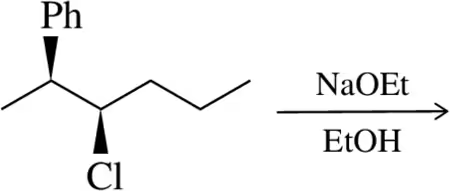
Paying close attention to the stereochemical outcome, predict the product of these elimination reactions. (a)
Verified step by step guidance
1
Identify the type of elimination reaction (E1 or E2) based on the reaction conditions. For example, strong bases and high temperatures typically favor E2, while weak bases and polar protic solvents favor E1.
Determine the structure of the starting material, including the location of the leaving group and any β-hydrogens (hydrogens on the carbon adjacent to the carbon bearing the leaving group).
For E2 reactions, consider the anti-periplanar geometry requirement. The β-hydrogen and the leaving group must be in opposite planes (180° apart) for the elimination to occur. Rotate the molecule, if necessary, to visualize this geometry.
For E1 reactions, the first step is the formation of a carbocation intermediate after the leaving group departs. Assess the stability of the carbocation and consider any possible rearrangements (e.g., hydride or alkyl shifts) that could lead to a more stable carbocation.
Once the elimination occurs, predict the major product by applying Zaitsev's rule (the more substituted alkene is generally favored) while also considering stereochemical outcomes, such as the formation of E (trans) or Z (cis) isomers, depending on the steric and electronic factors.
Verified video answer for a similar problem:
This video solution was recommended by our tutors as helpful for the problem above
Video duration:
4m
Play a video:
Was this helpful?
Key Concepts
Here are the essential concepts you must grasp in order to answer the question correctly.
Elimination Reactions
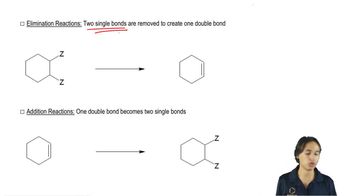
Elimination reactions involve the removal of atoms or groups from a molecule, resulting in the formation of a double bond or a ring structure. Common types include E1 and E2 mechanisms, which differ in their reaction pathways and stereochemical outcomes. Understanding the conditions and mechanisms of these reactions is crucial for predicting the products formed.
Stereochemistry is the study of the spatial arrangement of atoms in molecules and how this affects their chemical behavior. In elimination reactions, the stereochemical configuration of the starting material can influence the orientation of the double bond formed, leading to different stereoisomers. Recognizing the importance of stereochemistry is essential for predicting the correct product.
Zaitsev's Rule states that in elimination reactions, the more substituted alkene is typically the major product. This principle helps predict the outcome of reactions by favoring the formation of more stable alkenes, which are generally more substituted. Understanding this rule aids in anticipating the products based on the structure of the reactants.