Show how the following amino acids might be formed in the laboratory by reductive amination of the appropriate α-ketoacid. (a) alanine
Verified step by step guidance
1
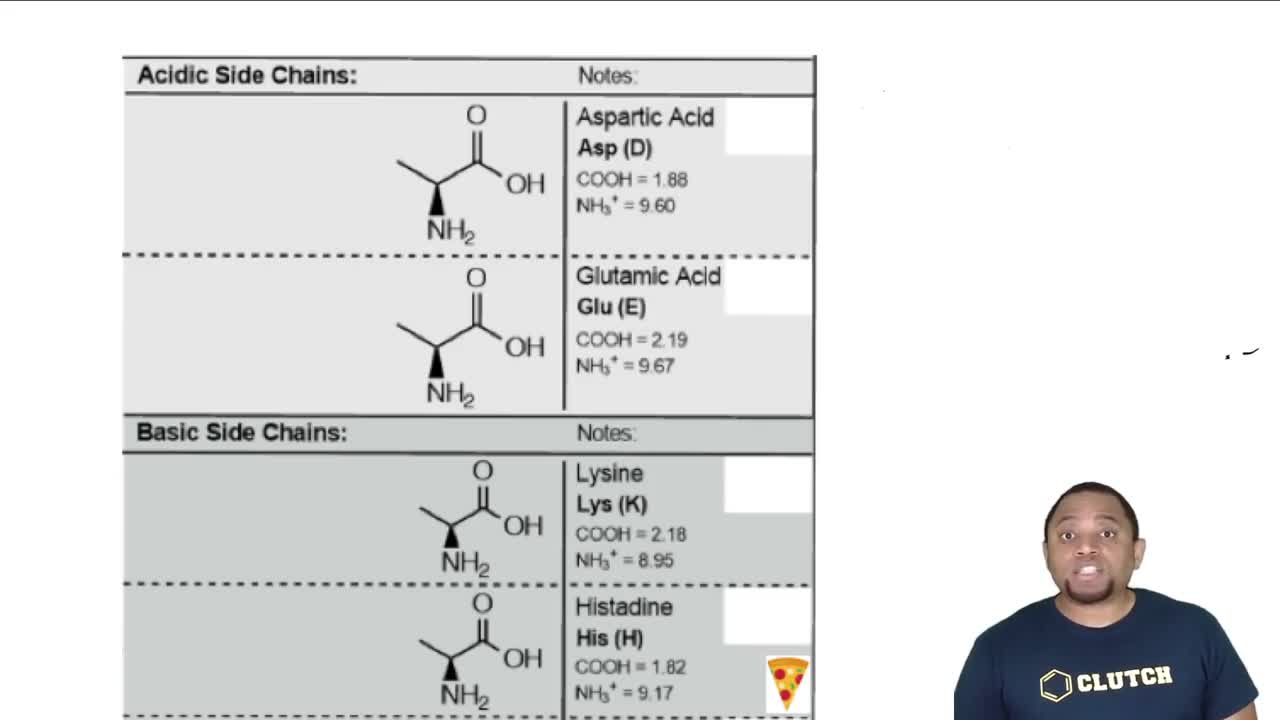
Identify the structure of alanine. Alanine is an amino acid with the structure CH₃-CH(NH₂)-COOH. This means the α-ketoacid precursor must have a similar structure but with a keto group (C=O) instead of the amino group (NH₂).
Determine the α-ketoacid precursor. Replace the amino group (-NH₂) in alanine with a keto group (-C=O) to get the α-ketoacid. The resulting structure is pyruvic acid (CH₃-CO-COOH).
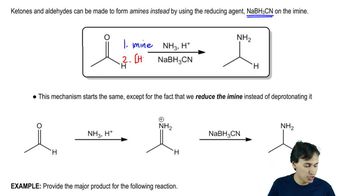
Understand the process of reductive amination. Reductive amination involves the reaction of an α-ketoacid with ammonia (NH₃) in the presence of a reducing agent, such as sodium cyanoborohydride (NaBH₃CN) or hydrogen gas (H₂) with a metal catalyst, to form an amino acid.
Write the reaction mechanism. In the first step, the α-ketoacid (pyruvic acid) reacts with ammonia to form an imine intermediate (CH₃-C=NH-COOH). This is a condensation reaction where water is eliminated.
Explain the reduction step. The imine intermediate is then reduced by the reducing agent (e.g., NaBH₃CN) to form alanine (CH₃-CH(NH₂)-COOH). This step adds hydrogen to the imine, converting the C=N bond into a C-NH₂ bond.
Verified video answer for a similar problem:
This video solution was recommended by our tutors as helpful for the problem above
Video duration:
2m
Play a video:
Was this helpful?
Key Concepts
Here are the essential concepts you must grasp in order to answer the question correctly.
Reductive Amination
Reductive amination is a chemical reaction that involves the conversion of a carbonyl compound, such as an α-ketoacid, into an amine. This process typically involves the addition of an amine to the carbonyl group, followed by reduction, often using a reducing agent like sodium cyanoborohydride. This reaction is crucial for synthesizing amino acids from their corresponding keto acids.
α-Ketoacids are organic compounds that contain a ketone functional group adjacent to a carboxylic acid group. They serve as important intermediates in various metabolic pathways and can be converted into amino acids through reductive amination. For alanine, the relevant α-ketoacid is pyruvate, which can be transformed into alanine by adding an amine group and reducing the carbonyl.
Amino Acid Structure
Amino acids are organic molecules that serve as the building blocks of proteins. Each amino acid has a central carbon atom bonded to an amino group, a carboxyl group, a hydrogen atom, and a variable R group that determines its unique properties. Understanding the structure of amino acids is essential for grasping how they are synthesized from α-ketoacids through reactions like reductive amination.