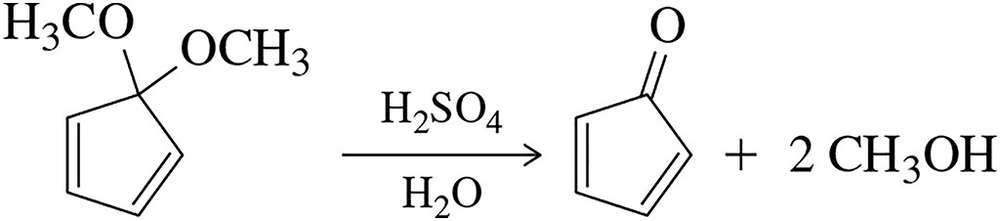
In Section 17.7.4, we studied the acid-catalyzed hydrolysis of acetals. The acetal shown here resists hydrolysis by the mechanism in Figure 17.63. Why? [Draw the intermediates as if the reaction would occur, then analyze the intermediates for any problems.]
Verified step by step guidance
1
Identify the acetal structure in the given compound. The acetal is characterized by two alkoxy groups (OCH3) attached to the same carbon atom.
Understand the mechanism of acid-catalyzed hydrolysis of acetals. This typically involves protonation of one of the alkoxy groups, making it a better leaving group.
Draw the first intermediate by protonating one of the methoxy groups (OCH3) using the acid catalyst (H2SO4). This will form a positively charged oxonium ion.
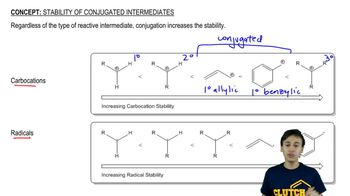
Consider the stability of the carbocation that would form if the methoxy group leaves. In this case, the carbocation would be on a carbon that is part of a five-membered ring, which is less stable due to ring strain.
Analyze the potential for resonance stabilization of the carbocation. In this structure, the carbocation cannot be stabilized by resonance with the aromatic ring, making it less favorable for the reaction to proceed.
Verified video answer for a similar problem:
This video solution was recommended by our tutors as helpful for the problem above
Play a video:
Was this helpful?
Key Concepts
Here are the essential concepts you must grasp in order to answer the question correctly.
Acetal Hydrolysis
Acetal hydrolysis is a reaction where acetals are converted back into their corresponding carbonyl compounds and alcohols in the presence of an acid and water. This process typically involves the protonation of the acetal oxygen, leading to the formation of a carbocation intermediate, which can then react with water to regenerate the carbonyl compound and alcohol. Understanding this mechanism is crucial for analyzing why certain acetals resist hydrolysis.
In acid-catalyzed reactions, the presence of an acid facilitates the reaction by protonating key functional groups, enhancing their reactivity. This mechanism often involves the formation of intermediates that can lead to different pathways, including rearrangements or elimination reactions. Analyzing the intermediates formed during the hydrolysis of acetals can reveal potential stability issues that prevent the reaction from proceeding.
The stability of intermediates formed during a chemical reaction is critical in determining the feasibility of the reaction pathway. In the case of acetal hydrolysis, if the intermediates are highly unstable or prone to rearrangement, the reaction may not proceed as expected. Evaluating the structure and electronic properties of these intermediates can provide insights into why certain acetals resist hydrolysis under acidic conditions.