Hydration of an aldehyde is also catalyzed by hydroxide ion. Propose a mechanism for the reaction.
Verified step by step guidance
1
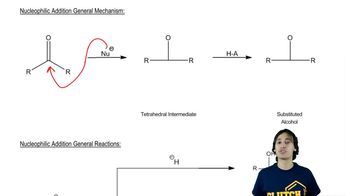
The first step in the mechanism is the nucleophilic attack of the hydroxide ion (OH⁻) on the carbonyl carbon of the aldehyde. This occurs because the carbonyl carbon is electrophilic due to the partial positive charge caused by the electronegativity difference between carbon and oxygen.
As the hydroxide ion attacks the carbonyl carbon, the π-electrons of the C=O bond are pushed onto the oxygen atom, creating a tetrahedral intermediate. This intermediate has a negatively charged oxygen atom (alkoxide ion).
In the next step, the negatively charged oxygen atom (alkoxide) abstracts a proton (H⁺) from water (H₂O), which acts as a proton donor. This step neutralizes the negative charge on the oxygen and forms a geminal diol (a compound with two hydroxyl groups attached to the same carbon).
The reaction is reversible, and the equilibrium between the aldehyde and the geminal diol is influenced by the stability of the aldehyde and the reaction conditions (e.g., pH, solvent).
The hydroxide ion acts as a catalyst in this reaction, as it is regenerated at the end of the mechanism. This means that the hydroxide ion facilitates the reaction without being consumed in the process.
Verified video answer for a similar problem:
This video solution was recommended by our tutors as helpful for the problem above
Video duration:
1m
Play a video:
Was this helpful?
Key Concepts
Here are the essential concepts you must grasp in order to answer the question correctly.
Aldehyde Structure and Reactivity
Aldehydes are organic compounds characterized by the presence of a carbonyl group (C=O) at the end of a carbon chain. This structure makes them highly reactive, particularly in nucleophilic addition reactions. Understanding the electrophilic nature of the carbonyl carbon is crucial, as it is susceptible to attack by nucleophiles, such as water in hydration reactions.
The nucleophilic addition mechanism involves the attack of a nucleophile on the electrophilic carbon of a carbonyl group. In the case of aldehydes, hydroxide ions (OH-) can act as nucleophiles, leading to the formation of a tetrahedral intermediate. This intermediate can then undergo protonation to yield the corresponding alcohol, illustrating the transformation of the aldehyde into a hydrated form.
Hydroxide ions can catalyze the hydration of aldehydes by facilitating the nucleophilic attack on the carbonyl carbon. As a base, OH- can enhance the reactivity of water, allowing for a more efficient formation of the tetrahedral intermediate. This catalytic role is essential in organic reactions, as it lowers the activation energy and increases the reaction rate without being consumed in the process.