What are the systematic names of the following compounds? Indicate the configuration (R or S) of each asymmetric center. a. D-glucose
Verified step by step guidance
1
Step 1: Understand the structure of d-glucose. d-Glucose is an aldohexose, meaning it is a six-carbon sugar with an aldehyde group at the first carbon. The remaining carbons (C2 to C6) have hydroxyl (-OH) groups attached, and the configuration of these groups determines the stereochemistry of the molecule.
Step 2: Assign priorities to the substituents on each chiral center using the Cahn-Ingold-Prelog (CIP) priority rules. For each chiral carbon, rank the four groups attached to it based on atomic number and connectivity.
Step 3: Determine the spatial arrangement of the substituents around each chiral center. Orient the molecule so that the lowest-priority group is pointing away from you (into the plane of the paper or screen). Then, trace a path from the highest-priority group to the second-highest and then to the third-highest.
Step 4: Assign the configuration (R or S) for each chiral center. If the path traced in Step 3 is clockwise, the configuration is R. If it is counterclockwise, the configuration is S. Repeat this process for all chiral centers in d-glucose (C2, C3, C4, and C5).
Step 5: Combine the stereochemical designations with the systematic name. The systematic name of d-glucose includes the stereochemical configuration of each chiral center (e.g., (2R, 3S, 4R, 5S)-2,3,4,5,6-pentahydroxyhexanal). Ensure that the name reflects the correct stereochemistry and functional groups.
Verified video answer for a similar problem:
This video solution was recommended by our tutors as helpful for the problem above
Video duration:
12m
Play a video:
Was this helpful?
Key Concepts
Here are the essential concepts you must grasp in order to answer the question correctly.
Systematic Naming of Organic Compounds
Systematic naming, or IUPAC nomenclature, is a standardized method for naming chemical compounds based on their structure. It involves identifying the longest carbon chain, functional groups, and stereochemistry to create a unique name that conveys the compound's structure. For carbohydrates like d-glucose, the name reflects the specific arrangement of atoms and functional groups.
Stereochemistry is the study of the spatial arrangement of atoms in molecules and how this affects their chemical behavior. Chiral centers, or asymmetric centers, are carbon atoms bonded to four different substituents, leading to non-superimposable mirror images called enantiomers. The configuration of these centers is designated as 'R' (rectus) or 'S' (sinister) based on the Cahn-Ingold-Prelog priority rules.
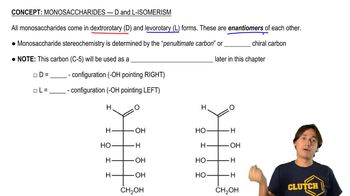
The D- and L- notation in sugars refers to the configuration of the highest-numbered chiral center relative to the reference molecule, glyceraldehyde. D-glucose, for example, has the hydroxyl group on the highest-numbered chiral center on the right in a Fischer projection. This notation is crucial for distinguishing between different stereoisomers of sugars, which can have vastly different biological activities.