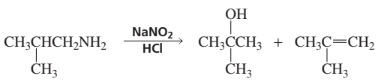
a. Explain why the following reaction leads to the products shown:
Verified step by step guidance
1
Step 1: Identify the type of reaction taking place. Determine whether it is a substitution, elimination, addition, or rearrangement reaction. This will help in understanding the mechanism and why the products are formed.
Step 2: Analyze the reactants and reagents involved. Look at the functional groups present in the starting material and the nature of the reagent (e.g., nucleophile, electrophile, acid, or base). This will provide clues about the reaction pathway.
Step 3: Consider the reaction mechanism. For example, if it is a substitution reaction, determine whether it follows an SN1 or SN2 mechanism. If it is an elimination reaction, decide whether it proceeds via an E1 or E2 pathway. Use the structure of the reactants and reaction conditions to justify the mechanism.
Step 4: Examine the stability of the intermediates and products. For example, in an SN1 reaction, the formation of a stable carbocation intermediate can explain why a particular product is favored. Similarly, in elimination reactions, the Zaitsev rule (formation of the more substituted alkene) often predicts the major product.
Step 5: Relate the reaction conditions to the observed products. For instance, if the reaction occurs under acidic or basic conditions, this can influence the pathway and the final products. Summarize how the mechanism and conditions lead to the specific products shown.
Verified video answer for a similar problem:
This video solution was recommended by our tutors as helpful for the problem above
Play a video:
Was this helpful?
Key Concepts
Here are the essential concepts you must grasp in order to answer the question correctly.
Reaction Mechanism
A reaction mechanism describes the step-by-step sequence of elementary reactions by which overall chemical change occurs. Understanding the mechanism helps in predicting the products formed in a reaction, as it outlines how reactants interact, transition states, and the formation of intermediates. This knowledge is crucial for explaining why specific products are generated.
Functional groups are specific groups of atoms within molecules that are responsible for the characteristic chemical reactions of those molecules. Recognizing the functional groups present in the reactants and products allows chemists to predict reactivity patterns and the types of transformations that can occur during a reaction, which is essential for explaining the observed products.
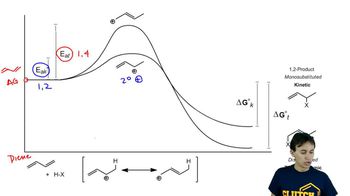
Thermodynamics and kinetics are two fundamental concepts in chemistry that explain the feasibility and rate of reactions, respectively. Thermodynamics assesses the energy changes and stability of reactants and products, while kinetics focuses on the speed of the reaction and the factors affecting it. Together, they provide insight into why a reaction proceeds to form specific products under given conditions.