Show how you would accomplish the following syntheses efficiently (you may use any necessary reagents). (c) but-2-enal → but-2-enoic acid
Verified step by step guidance
1
Identify the functional group transformation: The problem involves converting an aldehyde group (-CHO) in but-2-enal to a carboxylic acid group (-COOH) in but-2-enoic acid. This is an oxidation reaction.
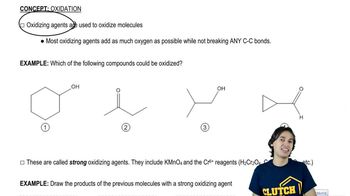
Choose an appropriate oxidizing agent: Aldehydes can be oxidized to carboxylic acids using oxidizing agents such as potassium permanganate (KMnO₄), chromium-based reagents (e.g., Jones reagent), or silver oxide (Ag₂O) in aqueous conditions.
Write the reaction mechanism: The aldehyde group in but-2-enal reacts with the oxidizing agent. The carbonyl carbon of the aldehyde is oxidized to form the carboxylic acid group. The double bond in the molecule remains unaffected because the oxidizing agents used are selective for aldehydes.
Ensure reaction conditions are mild: Use aqueous or slightly acidic conditions to facilitate the oxidation without affecting the double bond in the molecule. For example, KMnO₄ in a dilute solution under neutral or slightly basic conditions can be used.
Verify the product: The final product is but-2-enoic acid, which retains the double bond in the molecule while the aldehyde group is converted to a carboxylic acid group. Confirm the structure of the product to ensure the synthesis is complete.
Verified video answer for a similar problem:
This video solution was recommended by our tutors as helpful for the problem above
Video duration:
3m
Play a video:
Was this helpful?
Key Concepts
Here are the essential concepts you must grasp in order to answer the question correctly.
Aldol Condensation
Aldol condensation is a key reaction in organic chemistry where aldehydes or ketones with alpha-hydrogens react in the presence of a base to form β-hydroxy aldehydes or ketones. This reaction can lead to the formation of larger carbon skeletons and is crucial for synthesizing compounds like but-2-enoic acid from but-2-enal through subsequent dehydration.
Oxidation-reduction (redox) reactions involve the transfer of electrons between species, resulting in changes in oxidation states. In the context of converting but-2-enal to but-2-enoic acid, understanding how aldehydes can be oxidized to carboxylic acids is essential, as this transformation typically requires an oxidizing agent.
The choice of reagents and reaction conditions is critical in organic synthesis. For the conversion of but-2-enal to but-2-enoic acid, reagents such as potassium permanganate or chromium-based oxidants can be used to facilitate the oxidation process. Understanding the reactivity and selectivity of these reagents helps in designing efficient synthetic pathways.