Show how you would synthesize the following carboxylic acids, using the indicated starting materials. (e) p-xylene → terephthalic acid
Verified step by step guidance
1
Step 1: Recognize the structure of p-xylene. p-Xylene is a benzene ring with two methyl groups attached at the para positions (1,4-positions). The target molecule, terephthalic acid, is a benzene ring with two carboxylic acid groups at the para positions.
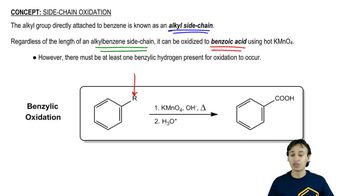
Step 2: Plan the oxidation of the methyl groups. To convert the methyl groups into carboxylic acid groups, you can use a strong oxidizing agent such as potassium permanganate (KMnO₄) or chromic acid (H₂CrO₄). These reagents are effective at oxidizing alkyl side chains on aromatic rings to carboxylic acids.
Step 3: Write the reaction conditions. Treat p-xylene with an aqueous solution of KMnO₄ under heat. The reaction proceeds through the oxidation of each methyl group (-CH₃) to a carboxylic acid group (-COOH). Ensure the reaction is carried out under acidic or neutral conditions to facilitate the oxidation.
Step 4: Consider the mechanism. The oxidation involves the formation of intermediate species such as benzyl alcohol and benzaldehyde, which are further oxidized to the carboxylic acid. However, under the strong oxidizing conditions, the reaction proceeds directly to the carboxylic acid stage.
Step 5: Verify the product. After the reaction, terephthalic acid (benzene-1,4-dicarboxylic acid) is formed. The two carboxylic acid groups are located at the para positions, confirming the successful synthesis from p-xylene.
Verified video answer for a similar problem:
This video solution was recommended by our tutors as helpful for the problem above
Video duration:
1m
Play a video:
0 Comments
Key Concepts
Here are the essential concepts you must grasp in order to answer the question correctly.
Carboxylic Acid Synthesis
Carboxylic acids can be synthesized through various methods, including oxidation of alcohols, carbonylation of alkenes, and the Kolbe electrolysis. Understanding these pathways is crucial for determining how to convert starting materials into the desired carboxylic acid. In this case, the transformation of p-xylene to terephthalic acid involves specific reactions that introduce carboxyl groups to the aromatic ring.
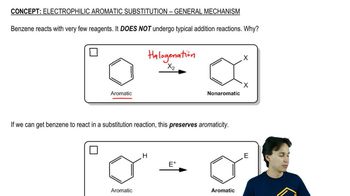
Electrophilic aromatic substitution (EAS) is a fundamental reaction in organic chemistry where an electrophile replaces a hydrogen atom on an aromatic ring. This concept is essential for understanding how functional groups can be introduced to aromatic compounds like p-xylene. The reaction conditions and the nature of the electrophile significantly influence the position and efficiency of substitution, which is key in synthesizing terephthalic acid.
Oxidation reactions involve the loss of electrons or an increase in oxidation state, often resulting in the formation of carboxylic acids from hydrocarbons. In the synthesis of terephthalic acid from p-xylene, oxidation is a critical step that converts the methyl groups on the aromatic ring into carboxylic acid groups. Understanding the types of oxidizing agents and their mechanisms is vital for successfully carrying out this transformation.


 1:31 minutes
 Verified step by step guidance
 04:20
04:20