(a) Outline the syntheses indicated in Solved Problem 18-2, beginning with aldehydes and alkyl halides. (b) Both of these syntheses of 1-phenylbuta-1,3-diene form the central double bond. Show how you would synthesize this target molecule by forming the terminal double bond.
Verified step by step guidance
1
Step 1: Analyze the target molecule, 1-phenylbuta-1,3-diene. It contains two conjugated double bonds, one of which is terminal. The synthesis will involve forming this terminal double bond using appropriate reagents and reactions.
Step 2: Consider the Wittig reaction as a method to form the terminal double bond. The Wittig reaction involves the reaction of an aldehyde with a phosphonium ylide to form an alkene. Identify the aldehyde and the ylide required for this synthesis.
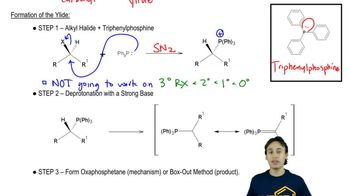
Step 3: To form the terminal double bond, select benzaldehyde (C₆H₅CHO) as the aldehyde and prepare the ylide from an alkyl halide such as methyltriphenylphosphonium bromide (CH₃PPh₃Br). The ylide is generated by treating the phosphonium salt with a strong base like n-butyllithium.
Step 4: React the benzaldehyde with the prepared ylide under appropriate conditions to form the terminal double bond, resulting in the target molecule, 1-phenylbuta-1,3-diene.
Step 5: Verify the structure of the product to ensure the terminal double bond has been formed correctly and matches the target molecule. This step may involve spectroscopic analysis or comparison with known data.
Verified video answer for a similar problem:
This video solution was recommended by our tutors as helpful for the problem above
Video duration:
14m
Play a video:
Was this helpful?
Key Concepts
Here are the essential concepts you must grasp in order to answer the question correctly.
Aldehydes and Alkyl Halides
Aldehydes are organic compounds containing a carbonyl group (C=O) bonded to at least one hydrogen atom, making them reactive in various synthesis reactions. Alkyl halides, on the other hand, are compounds where a halogen atom (like Cl, Br, or I) is attached to an alkyl group. Both functional groups are crucial in organic synthesis, particularly in forming carbon-carbon bonds through nucleophilic substitution or addition reactions.
The formation of double bonds in organic molecules often involves elimination reactions, where two atoms or groups are removed from adjacent carbon atoms, resulting in a double bond. In the context of synthesizing 1-phenylbuta-1,3-diene, understanding how to manipulate the position of double bonds is essential, as it can significantly affect the reactivity and properties of the resulting compound.
Phosphorus ylides are reactive intermediates used in the synthesis of alkenes, particularly through the Wittig reaction. They are formed by the reaction of a phosphonium salt with a strong base, leading to the generation of a nucleophilic carbon that can react with carbonyl compounds to form alkenes. This concept is vital for understanding the alternative synthetic pathways to create the desired double bond in 1-phenylbuta-1,3-diene.