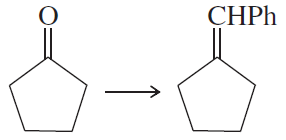
Show how you would accomplish the following syntheses efficiently and in good yield. You may use any necessary reagents. (b)
Verified step by step guidance
1
Step 1: Analyze the starting material and product. The starting material is cyclohexanone, a ketone, and the product is a cyclohexane ring with a phenyl-substituted alkene. This suggests the reaction involves forming a new carbon-carbon bond and introducing an alkene functionality.
Step 2: Consider the mechanism for forming the alkene and phenyl group. A common approach is the Wittig reaction, which converts a ketone into an alkene using a phosphonium ylide. Prepare the ylide by reacting triphenylphosphine with an appropriate alkyl halide, such as benzyl bromide.
Step 3: Generate the phosphonium ylide. React triphenylphosphine with benzyl bromide to form the phosphonium salt, then deprotonate the salt using a strong base like sodium hydride (NaH) to form the ylide.
Step 4: Perform the Wittig reaction. React the cyclohexanone with the prepared phosphonium ylide under appropriate conditions to form the desired alkene product. This step involves the formation of a carbon-carbon double bond between the cyclohexane ring and the benzyl group.
Step 5: Purify the product. Use techniques such as distillation or chromatography to isolate the desired product in good yield and ensure its purity.
Verified video answer for a similar problem:
This video solution was recommended by our tutors as helpful for the problem above
Video duration:
12m
Play a video:
Was this helpful?
Key Concepts
Here are the essential concepts you must grasp in order to answer the question correctly.
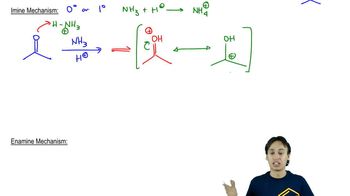
Imine Formation
Imine formation is a reaction between an aldehyde or ketone and a primary amine, resulting in the creation of an imine. This process involves the nucleophilic attack of the amine on the carbonyl carbon, followed by dehydration to eliminate water. Understanding this reaction is crucial for synthesizing compounds that contain imine functional groups, which are important in various organic reactions.
Aldehydes are highly reactive due to the presence of a carbonyl group (C=O), which is polarized, making the carbon susceptible to nucleophilic attack. This reactivity allows aldehydes to participate in various reactions, including nucleophilic addition and condensation reactions. Recognizing the reactivity of aldehydes is essential for predicting the outcomes of synthetic pathways involving these compounds.
The phenyl group (C6H5) is a stable aromatic substituent that can influence the reactivity and stability of adjacent functional groups. In the context of imine synthesis, the presence of a phenyl group can enhance the electrophilicity of the carbonyl carbon, facilitating the formation of the imine. Understanding the electronic effects of substituents like the phenyl group is important for optimizing reaction conditions and yields.