The Stille reaction is similar to the Suzuki reaction. It replaces the alkenyl-organoboron compound of the Suzuki reaction with an alkenyl-organotin compound. (R is an alkyl group such as methyl or butyl.) Unlike the alkenyl-organoboron compound that always has a trans configuration, the alkenyl-organotin compound can have a cis configuration. What is the product of the Stille reaction shown here?
Verified step by step guidance
1
Step 1: Recognize the reaction type. The Stille reaction is a palladium-catalyzed cross-coupling reaction between an organohalide (in this case, a bromide) and an organotin compound. The goal is to form a new carbon-carbon bond between the two reactants.
Step 2: Analyze the reactants. The organohalide is a cyclohexenyl bromide, which contains a double bond in the cyclohexene ring. The organotin compound is an alkenyl-organotin species, specifically a vinyl group attached to tin (Sn(R)3).
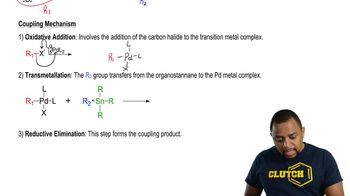
Step 3: Understand the mechanism. The palladium catalyst (L2Pd) facilitates the oxidative addition of the bromide to palladium, forming a Pd(II) complex. This is followed by transmetalation, where the alkenyl group from the organotin compound is transferred to the palladium complex.
Step 4: Consider the stereochemistry. The alkenyl-organotin compound can have cis or trans configurations. The stereochemistry of the product depends on the configuration of the alkenyl-organotin compound used in the reaction.
Step 5: Predict the product. The final step in the Stille reaction is reductive elimination, where the alkenyl group from the organotin compound and the cyclohexenyl group from the organohalide combine to form a new carbon-carbon double bond. The product will be a conjugated diene, specifically 1-vinylcyclohexene.
Verified video answer for a similar problem:
This video solution was recommended by our tutors as helpful for the problem above
Video duration:
2m
Play a video:
Was this helpful?
Key Concepts
Here are the essential concepts you must grasp in order to answer the question correctly.
Stille Reaction
The Stille reaction is a cross-coupling reaction that involves the coupling of an organotin compound with an organic halide in the presence of a palladium catalyst. This reaction is particularly useful for forming carbon-carbon bonds and is widely applied in organic synthesis. The ability of organotin compounds to participate in this reaction allows for the introduction of various alkenyl groups into organic molecules.
Organotin compounds are organometallic compounds that contain tin bonded to carbon. They are often used in the Stille reaction due to their stability and reactivity. Unlike organoboron compounds, organotin compounds can exist in both cis and trans configurations, which can influence the stereochemistry of the final product in reactions where stereochemistry is critical.
Stereochemistry refers to the study of the spatial arrangement of atoms in molecules and how this affects their chemical behavior. In the context of the Stille reaction, the configuration of the alkenyl-organotin compound (cis or trans) can lead to different stereoisomers in the product. Understanding stereochemistry is essential for predicting the properties and reactivity of the resulting compounds.