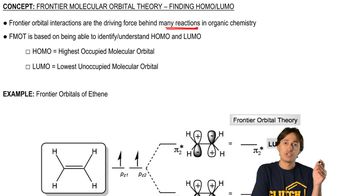
Identify the HOMO and LUMO of the allylic cation and the allylic anion shown in Figure 21.22. <IMAGE>
Verified step by step guidance
1
Step 1: Understand the concepts of HOMO (Highest Occupied Molecular Orbital) and LUMO (Lowest Unoccupied Molecular Orbital). HOMO represents the molecular orbital containing the highest energy electrons, while LUMO represents the molecular orbital that is ready to accept electrons.
Step 2: Recall that allylic systems involve conjugation, where π-electrons are delocalized over three atoms. This delocalization creates molecular orbitals with different energy levels.
Step 3: For the allylic cation, note that it has one fewer electron in the π-system compared to the neutral allylic species. This means the HOMO will be the highest-energy π-orbital that is occupied, and the LUMO will be the next higher-energy π-orbital that is unoccupied.
Step 4: For the allylic anion, note that it has one additional electron in the π-system compared to the neutral allylic species. This means the HOMO will be the highest-energy π-orbital that is occupied, and the LUMO will be the next higher-energy π-orbital that is unoccupied.
Step 5: To identify the specific molecular orbitals, analyze the energy diagram of the allylic system (Figure 21.22). The allylic cation will have a lower HOMO energy due to the electron deficiency, while the allylic anion will have a higher HOMO energy due to the extra electron. The LUMO for both species will depend on the next available unoccupied orbital in the π-system.
Verified video answer for a similar problem:
This video solution was recommended by our tutors as helpful for the problem above
Video duration:
8m
Play a video:
Was this helpful?
Key Concepts
Here are the essential concepts you must grasp in order to answer the question correctly.
HOMO and LUMO
HOMO (Highest Occupied Molecular Orbital) and LUMO (Lowest Unoccupied Molecular Orbital) are fundamental concepts in molecular orbital theory. The HOMO is the highest energy orbital that contains electrons, while the LUMO is the lowest energy orbital that is empty. The energy gap between these two orbitals is crucial for understanding the reactivity and stability of molecules, as it influences how they interact with other species.
An allylic cation is a positively charged species where the positive charge is located on a carbon atom adjacent to a double bond, while an allylic anion has a negative charge on a similar carbon atom. These species are important in organic chemistry due to their unique stability and reactivity patterns, which arise from resonance stabilization. Understanding their structure helps in predicting their behavior in chemical reactions.
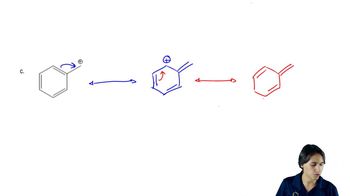
Resonance is a concept used to describe the delocalization of electrons in molecules where the electron distribution cannot be represented by a single Lewis structure. In the case of allylic cations and anions, resonance allows for the charge to be spread over multiple atoms, enhancing stability. This delocalization is key to understanding the properties and reactivity of these intermediates in organic reactions.