


Each of the IR spectra shown below is accompanied by a set of four compounds. In each case, indicate which of the four compounds is responsible for the spectrum. a. <IMAGE>
Verified step by step guidance
1
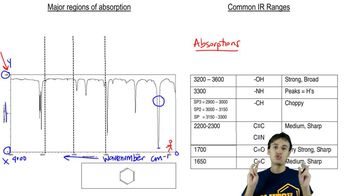
Step 1: Begin by analyzing the IR spectrum provided. Identify the key absorption peaks and their corresponding wavenumbers (in cm⁻¹). Look for characteristic functional group signals such as O-H, N-H, C=O, C-H, C≡C, or C≡N stretches.
Step 2: Compare the observed absorption peaks with the known IR absorption ranges for functional groups. For example, a broad peak around 3200-3600 cm⁻¹ suggests an O-H stretch (alcohol or carboxylic acid), while a sharp peak near 1700 cm⁻¹ indicates a C=O stretch (carbonyl group).
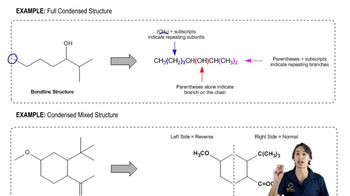
Step 3: Examine the molecular structures of the four compounds provided. Identify the functional groups present in each compound and predict the IR absorption peaks they would produce.
Step 4: Match the observed IR spectrum with the predicted peaks for each compound. Focus on unique or distinguishing peaks that can help differentiate between the compounds.
Step 5: Based on the comparison, determine which compound's functional groups and predicted IR absorptions align best with the observed spectrum. This compound is responsible for the given IR spectrum.
Verified video answer for a similar problem:
This video solution was recommended by our tutors as helpful for the problem above
Video duration:
2m
Play a video:
Was this helpful?
Key Concepts
Here are the essential concepts you must grasp in order to answer the question correctly.
Infrared Spectroscopy (IR)
Infrared spectroscopy is an analytical technique used to identify molecular structures by measuring the absorption of infrared light by a sample. Different functional groups in a molecule absorb characteristic wavelengths of IR radiation, resulting in a spectrum that can be analyzed to determine the presence of specific bonds and functional groups.
Functional groups are specific groups of atoms within molecules that are responsible for the characteristic chemical reactions of those molecules. Common functional groups include hydroxyl (-OH), carbonyl (C=O), and carboxyl (-COOH). Identifying these groups in a compound is crucial for interpreting IR spectra, as each group has a unique absorption pattern.
Interpreting an IR spectrum involves analyzing the peaks and troughs that correspond to different vibrational modes of molecular bonds. The position and intensity of these peaks provide information about the types of bonds present in the compound. By comparing the observed spectrum with known reference spectra, one can deduce which compound corresponds to the given spectrum.