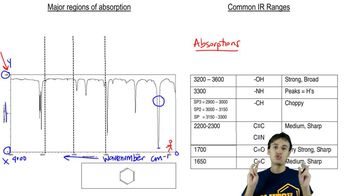
Each of the IR spectra shown below is the spectrum of one of the following compounds. Identify the compound that produced each spectrum. a. <IMAGE>
Verified step by step guidance
1
Step 1: Analyze the IR spectrum provided. The broad peak around 3300 cm⁻¹ indicates the presence of an N-H or O-H bond, which is characteristic of amines or alcohols. The absence of a sharp peak around 1700 cm⁻¹ suggests that there is no carbonyl group (C=O) in the compound.
Step 2: Compare the IR spectrum with the functional groups in the given compounds. Compound (i) contains an amine group (-NH₂) attached to a cyclohexane ring, which matches the broad peak around 3300 cm⁻¹. Compound (ii) contains both an amine group and a carbonyl group, but the IR spectrum does not show a strong peak around 1700 cm⁻¹, ruling out this compound.
Step 3: Compound (iii) contains an aromatic amine group (-NH₂) attached to a benzene ring. Aromatic compounds typically show peaks in the region of 1500-1600 cm⁻¹ due to C=C stretching, which is not prominent in the IR spectrum provided. This suggests that compound (iii) is not the correct match.
Step 4: Compound (iv) contains a carboxylic acid group (-COOH), which would show a broad O-H stretch around 3000 cm⁻¹ and a sharp C=O stretch around 1700 cm⁻¹. Since the IR spectrum lacks a sharp peak at 1700 cm⁻¹, compound (iv) is not the correct match.
Step 5: Based on the analysis, the IR spectrum corresponds to compound (i), which contains an amine group (-NH₂) attached to a cyclohexane ring. The broad peak around 3300 cm⁻¹ is consistent with the N-H stretching vibration of the amine group.
Verified video answer for a similar problem:
This video solution was recommended by our tutors as helpful for the problem above
Video duration:
4m
Play a video:
Was this helpful?
Key Concepts
Here are the essential concepts you must grasp in order to answer the question correctly.
Infrared Spectroscopy (IR)
Infrared spectroscopy is a technique used to identify and study chemicals based on their absorption of infrared light. Molecules absorb specific wavelengths of IR radiation, causing vibrations in their bonds. The resulting spectrum displays transmittance versus wavenumber, revealing characteristic peaks that correspond to functional groups within the molecule.
Functional groups are specific groups of atoms within molecules that are responsible for the characteristic chemical reactions of those molecules. Common functional groups include hydroxyl (-OH), carbonyl (C=O), and carboxylic acid (-COOH). Identifying these groups in an IR spectrum helps in determining the structure of the compound being analyzed.
In an IR spectrum, peaks represent the frequencies at which a molecule absorbs infrared light, indicating the presence of specific functional groups. The position and intensity of these peaks provide information about bond types and molecular structure. For example, a broad peak around 3200-3600 cm⁻¹ typically indicates the presence of an -OH group, while sharp peaks in the 1700-1750 cm⁻¹ range suggest a carbonyl group.