Propose mechanisms for (a) the acid-catalyzed hydration of chloral to form chloral hydrate.
Verified step by step guidance
1
Identify the reactants and products: The reactant is chloral (CCl₃CHO), and the product is chloral hydrate (CCl₃CH(OH)₂). This reaction involves the addition of water to the carbonyl group of chloral under acidic conditions.
Step 1: Protonation of the carbonyl group. The acid catalyst donates a proton (H⁺) to the oxygen atom of the carbonyl group in chloral, increasing the electrophilicity of the carbonyl carbon. This forms a protonated intermediate.
Step 2: Nucleophilic attack by water. A water molecule acts as a nucleophile and attacks the electrophilic carbonyl carbon, forming a tetrahedral intermediate. This step introduces an -OH group to the carbon.
Step 3: Deprotonation of the intermediate. The tetrahedral intermediate formed in the previous step undergoes deprotonation (loss of H⁺) to stabilize the structure, resulting in the formation of a geminal diol (chloral hydrate).
Step 4: Regeneration of the acid catalyst. The proton (H⁺) lost during the deprotonation step is returned to the solution, ensuring that the acid catalyst is regenerated and the reaction can proceed catalytically.
Verified video answer for a similar problem:
This video solution was recommended by our tutors as helpful for the problem above
Video duration:
3m
Play a video:
Was this helpful?
Key Concepts
Here are the essential concepts you must grasp in order to answer the question correctly.
Acid-Catalyzed Hydration
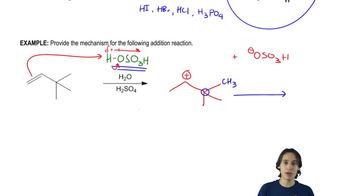
Acid-catalyzed hydration is a chemical reaction where water is added to a compound in the presence of an acid, which acts as a catalyst. The acid protonates the carbonyl oxygen of the compound, increasing its electrophilicity and facilitating the nucleophilic attack by water. This process is crucial in converting carbonyl compounds into their corresponding alcohols or hydrates.
Chloral is an organic compound with the formula CCl3CHO, characterized by its carbonyl group. When chloral undergoes hydration, it forms chloral hydrate, a stable compound used in various applications, including as a sedative. Understanding the structure and reactivity of chloral is essential for proposing the hydration mechanism.
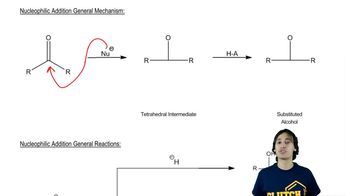
The mechanism of nucleophilic addition involves the attack of a nucleophile, such as water, on an electrophilic center, typically a carbon atom in a carbonyl group. This reaction proceeds through the formation of a tetrahedral intermediate, which can then collapse to yield the final product. Recognizing this mechanism is vital for understanding how chloral is converted to chloral hydrate.