Propose mechanisms for (b) the base-catalyzed hydration of acetone to form acetone hydrate.
Verified step by step guidance
1
Identify the reactants and products: The reactant is acetone (CH₃COCH₃), and the product is acetone hydrate (CH₃C(OH)₂CH₃). The reaction is base-catalyzed, so a hydroxide ion (OH⁻) will play a key role in the mechanism.
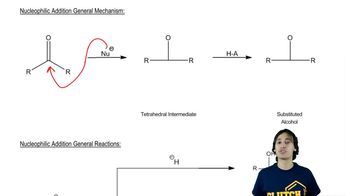
Step 1: Nucleophilic attack by hydroxide ion (OH⁻): The hydroxide ion attacks the electrophilic carbonyl carbon of acetone. This is because the carbonyl carbon is partially positive due to the electronegativity of the oxygen atom. This step forms a tetrahedral intermediate where the carbonyl oxygen now carries a negative charge.
Step 2: Protonation of the negatively charged oxygen: The negatively charged oxygen in the tetrahedral intermediate abstracts a proton (H⁺) from water (H₂O), forming the acetone hydrate (CH₃C(OH)₂CH₃). This step regenerates the hydroxide ion (OH⁻), which acts as the catalyst.
Step 3: Confirm the catalytic role of the base: Since the hydroxide ion is regenerated at the end of the reaction, it acts as a catalyst and is not consumed in the overall process. This confirms the base-catalyzed nature of the reaction.
Step 4: Summarize the mechanism: The base-catalyzed hydration of acetone involves two key steps: (1) nucleophilic attack by OH⁻ on the carbonyl carbon, forming a tetrahedral intermediate, and (2) protonation of the intermediate by water to yield the hydrate product. The hydroxide ion is regenerated, completing the catalytic cycle.
Verified video answer for a similar problem:
This video solution was recommended by our tutors as helpful for the problem above
Video duration:
3m
Play a video:
Was this helpful?
Key Concepts
Here are the essential concepts you must grasp in order to answer the question correctly.
Base-Catalyzed Hydration
Base-catalyzed hydration involves the addition of water to a carbonyl compound, facilitated by a base. In this process, the base deprotonates water to generate hydroxide ions, which then attack the electrophilic carbon of the carbonyl group. This reaction typically leads to the formation of an alcohol or hydrate, depending on the conditions and the substrate.
The mechanism of nucleophilic addition is a fundamental reaction in organic chemistry where a nucleophile attacks an electrophilic center, such as a carbonyl carbon. In the case of acetone hydration, the hydroxide ion acts as the nucleophile, attacking the carbonyl carbon of acetone, leading to the formation of a tetrahedral intermediate that can rearrange to form the hydrate.
Hydration reactions often reach an equilibrium state, where the forward and reverse reactions occur at the same rate. For acetone hydration, this means that the formation of acetone hydrate and the reversion to acetone and water can coexist. Understanding this equilibrium is crucial for predicting the extent of hydration under different conditions, such as concentration and temperature.