
The following NMR spectra correspond to compound of formula (C) C6H10O2. Propose structure, and show how it is consistent with the observed absorptions. <IMAGE>
Verified step by step guidance
1
Analyze the molecular formula (C6H10O2) to determine the degree of unsaturation. Use the formula: Degree of Unsaturation = (2C + 2 - H + N - X)/2, where C = number of carbons, H = number of hydrogens, N = number of nitrogens, and X = number of halogens. For this compound, calculate the degree of unsaturation to identify the presence of rings or double bonds.
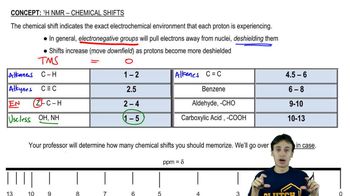
Examine the NMR spectra for key features. Look for chemical shifts, splitting patterns, and integration values. For example, chemical shifts in the range of 9-10 ppm suggest aldehydes, 2-3 ppm suggest protons near electronegative atoms, and 0-2 ppm suggest alkyl protons. Integration values will help determine the number of protons contributing to each signal.
Identify functional groups based on the NMR data and the molecular formula. For example, if you observe a peak around 170-180 ppm in the 13C NMR spectrum, it may indicate the presence of a carbonyl group (C=O). Combine this information with the degree of unsaturation to narrow down possible structures.
Propose a structure that fits the molecular formula and is consistent with the NMR data. For example, if the degree of unsaturation is 2 and the NMR data suggests a carbonyl group and an ester functional group, consider structures like esters or cyclic ketones.
Verify the proposed structure by matching all observed NMR signals to the protons and carbons in the structure. Ensure that the chemical shifts, splitting patterns, and integration values align with the proposed structure. If discrepancies arise, revisit the analysis and adjust the structure accordingly.
Verified video answer for a similar problem:
This video solution was recommended by our tutors as helpful for the problem above
Video duration:
3m
Play a video:
Was this helpful?
Key Concepts
Here are the essential concepts you must grasp in order to answer the question correctly.
Nuclear Magnetic Resonance (NMR) Spectroscopy
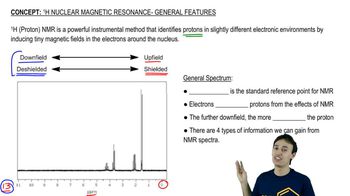
NMR spectroscopy is a powerful analytical technique used to determine the structure of organic compounds. It relies on the magnetic properties of certain nuclei, primarily hydrogen (1H) and carbon (13C), to provide information about the number of hydrogen atoms, their environment, and connectivity in a molecule. The resulting spectra display peaks that correspond to different chemical environments, allowing chemists to deduce structural features.
Chemical shift refers to the position of a peak in an NMR spectrum, which indicates the electronic environment surrounding a nucleus. It is measured in parts per million (ppm) and varies based on factors such as electronegativity and hybridization of nearby atoms. Understanding chemical shifts is crucial for interpreting NMR data, as they help identify functional groups and the overall structure of the compound.
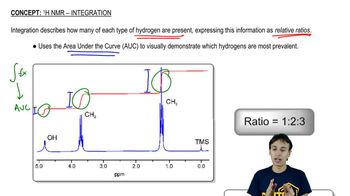
Integration in NMR refers to the area under a peak, which correlates to the number of protons contributing to that signal. Multiplicity describes the splitting pattern of a peak, indicating how many neighboring protons are present (n+1 rule). Together, integration and multiplicity provide insights into the number of hydrogen atoms in different environments and their connectivity, essential for constructing the molecular structure.