Draw the products obtained from the SN2 reaction of: c. (S)-3-chlorohexane and hydroxide ion. d. 3-iodopentane and hydroxide ion.
Verified step by step guidance
1
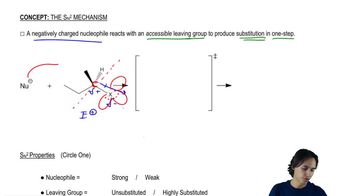
Step 1: Understand the SN2 reaction mechanism. The SN2 reaction is a bimolecular nucleophilic substitution reaction where the nucleophile attacks the electrophilic carbon from the opposite side of the leaving group, leading to an inversion of configuration at the carbon center.
Step 2: For part (c), identify the substrate and nucleophile. The substrate is (S)-3-chlorohexane, which has a chiral center at carbon-3. The nucleophile is the hydroxide ion (OH⁻), and the leaving group is the chloride ion (Cl⁻).
Step 3: Predict the stereochemical outcome for part (c). Since the SN2 reaction proceeds with inversion of configuration, the product will have the opposite configuration at the chiral center. The product will be (R)-3-hexanol, where the hydroxide ion replaces the chloride ion.
Step 4: For part (d), identify the substrate and nucleophile. The substrate is 3-iodopentane, which does not have a chiral center. The nucleophile is the hydroxide ion (OH⁻), and the leaving group is the iodide ion (I⁻).
Step 5: Predict the product for part (d). Since there is no chiral center, the SN2 reaction will simply result in the substitution of the iodide ion with the hydroxide ion, forming 3-pentanol as the product.
Verified video answer for a similar problem:
This video solution was recommended by our tutors as helpful for the problem above
Video duration:
7m
Play a video:
Was this helpful?
Key Concepts
Here are the essential concepts you must grasp in order to answer the question correctly.
SN2 Reaction Mechanism
The SN2 (substitution nucleophilic bimolecular) reaction is a type of nucleophilic substitution where a nucleophile attacks an electrophile, resulting in the simultaneous displacement of a leaving group. This mechanism involves a single concerted step, leading to the formation of a transition state where both the nucleophile and the leaving group are partially bonded to the carbon atom. The reaction typically occurs with primary or secondary substrates due to steric hindrance.
Stereochemistry plays a crucial role in SN2 reactions, as the nucleophile attacks the electrophile from the opposite side of the leaving group, leading to an inversion of configuration at the chiral center. This means that if the starting material is chiral, the product will have the opposite configuration. Understanding this inversion is essential for predicting the stereochemical outcome of reactions involving chiral substrates.
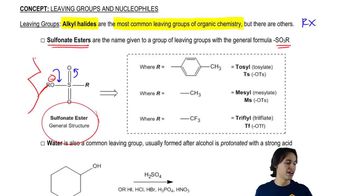
Nucleophilicity refers to the ability of a species to donate an electron pair to form a new bond, while leaving groups are atoms or groups that can depart with a pair of electrons during a reaction. In SN2 reactions, strong nucleophiles, such as hydroxide ions, effectively attack the electrophile, while good leaving groups, like chloride or iodide ions, facilitate the reaction by stabilizing the transition state. The strength of both factors significantly influences the reaction rate and product formation.