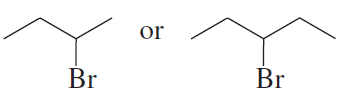
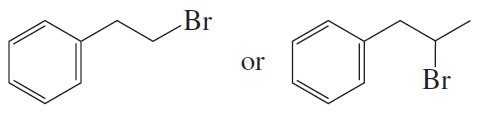
Which alkyl halide is more reactive in an SN2 reaction with a given nucleophile? c. d.
Verified step by step guidance
1
Step 1: Understand the SN2 reaction mechanism. SN2 reactions are bimolecular nucleophilic substitution reactions where the nucleophile attacks the electrophilic carbon and displaces the leaving group in a single step. The reaction rate depends on steric hindrance and the quality of the leaving group.
Step 2: Analyze the leaving group. In part (a), the leaving group is iodine (I), which is a better leaving group than chlorine (Cl) due to its larger size and weaker bond to carbon. This makes the alkyl halide with iodine more reactive in SN2 reactions.
Step 3: Consider steric hindrance. In part (a), the alkyl halide with iodine on the secondary carbon is less sterically hindered compared to the alkyl halide with iodine on the tertiary carbon. SN2 reactions favor less sterically hindered substrates, so the secondary alkyl halide is more reactive.
Step 4: Examine the structure in part (b). The first structure has a benzyl chloride, where the leaving group is attached to a benzylic carbon. Benzyl carbons are less sterically hindered and stabilize the transition state due to resonance. The second structure has a chlorine attached to a primary alkyl chain, which is also favorable for SN2 but lacks resonance stabilization.
Step 5: Compare the reactivity in part (b). Benzyl chloride is more reactive in SN2 reactions compared to the primary alkyl chloride because the benzylic position provides resonance stabilization to the transition state, enhancing the reaction rate.
Verified video answer for a similar problem:
This video solution was recommended by our tutors as helpful for the problem above
Video duration:
4m
Play a video:
Was this helpful?
Key Concepts
Here are the essential concepts you must grasp in order to answer the question correctly.
SN2 Mechanism
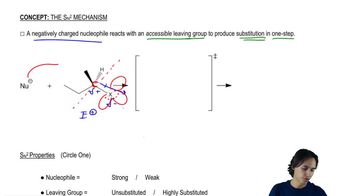
The SN2 (substitution nucleophilic bimolecular) mechanism involves a single concerted step where a nucleophile attacks an electrophile, resulting in the displacement of a leaving group. This reaction is characterized by a backside attack, leading to inversion of configuration at the carbon center. The rate of the reaction depends on the concentration of both the nucleophile and the substrate.
Steric hindrance refers to the crowding around a reactive site that can impede the approach of a nucleophile. In SN2 reactions, primary alkyl halides are more reactive than secondary or tertiary ones due to less steric hindrance. The presence of bulky groups near the reactive carbon can significantly slow down or prevent the reaction.
The ability of a leaving group to depart from the substrate is crucial in determining the reactivity of alkyl halides in SN2 reactions. Good leaving groups, such as iodide (I-) and bromide (Br-), stabilize the negative charge after leaving, facilitating the reaction. Conversely, poor leaving groups, like chloride (Cl-), hinder the reaction rate, making the substrate less reactive.