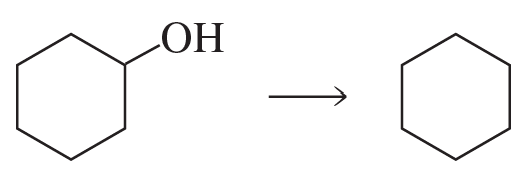
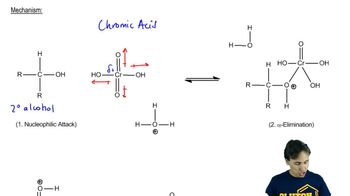
Using the given starting material, any necessary inorganic reagents, and any carbon-containing compounds with no more than two carbons, indicate how the following syntheses could be carried out: a.
Verified step by step guidance
1
Analyze the target molecule and the starting material to identify the functional groups present and the changes required to convert the starting material into the target molecule. This includes identifying any new bonds formed or broken, as well as any rearrangements or functional group transformations.
Determine the reagents and reactions needed to achieve the required transformations. For example, if a carbon-carbon bond needs to be formed, consider reactions like alkylation, aldol condensation, or Grignard reactions. If a functional group needs to be modified, consider oxidation, reduction, or substitution reactions.
Plan the synthesis step-by-step, ensuring that each intermediate is chemically feasible and that the reagents used are compatible with the functional groups present. For example, if the starting material contains a hydroxyl group, ensure that it is protected if necessary before proceeding with reactions that might affect it.
Verify that the carbon-containing compounds used in the synthesis have no more than two carbons, as per the problem's constraints. For example, you can use compounds like ethylene, acetylene, or formaldehyde as building blocks.
Write out the reaction sequence, including the starting material, intermediates, reagents, and conditions for each step. Ensure that the final product matches the target molecule in structure and stereochemistry.
Verified video answer for a similar problem:
This video solution was recommended by our tutors as helpful for the problem above
Video duration:
2m
Play a video:
Was this helpful?
Key Concepts
Here are the essential concepts you must grasp in order to answer the question correctly.
Organic Synthesis
Organic synthesis is the process of constructing organic compounds through a series of chemical reactions. It involves the strategic selection of starting materials, reagents, and reaction conditions to achieve the desired product. Understanding the principles of organic synthesis is crucial for designing pathways that efficiently convert simple molecules into more complex structures.
Synthesis of Amino Acids: Strecker Synthesis Example 1
Reagents and Reaction Mechanisms
Reagents are substances used to bring about a chemical reaction, and understanding their roles is essential in organic chemistry. Different reagents can facilitate various types of reactions, such as nucleophilic substitutions or eliminations. Familiarity with reaction mechanisms helps predict the outcome of reactions and the conditions required for successful synthesis.
Functional groups are specific groups of atoms within molecules that are responsible for the characteristic chemical reactions of those molecules. Identifying functional groups is vital for predicting reactivity and guiding the synthesis process. Knowledge of how different functional groups interact allows chemists to manipulate and transform organic compounds effectively.