Which of the following structures represent the same compound? Which ones represent different compounds? (a)
Verified step by step guidance
1
Examine each structure carefully to identify the number of carbon atoms and their connectivity. This will help determine if they represent the same compound or different compounds.
Structure 1 and Structure 2 both have a straight chain of five carbon atoms, indicating they are likely the same compound, pentane.
Structure 3 has a branching at the second carbon, with two methyl groups attached, indicating it is 2,2-dimethylbutane, a different compound from Structures 1 and 2.
Structure 4 has a branching at the first carbon, with two methyl groups attached, indicating it is 2,2-dimethylpropane, a different compound from Structures 1, 2, and 3.
Structure 5 has a branching at the second carbon, with two methyl groups attached, similar to Structure 3, indicating it is also 2,2-dimethylbutane, the same compound as Structure 3.
Verified video answer for a similar problem:
This video solution was recommended by our tutors as helpful for the problem above
Video duration:
2m
Play a video:
Was this helpful?
Key Concepts
Here are the essential concepts you must grasp in order to answer the question correctly.
Structural Isomers
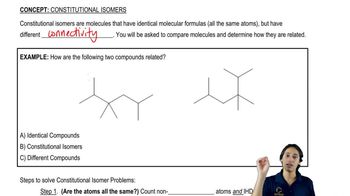
Structural isomers are compounds that have the same molecular formula but differ in the connectivity of their atoms. This means that while they contain the same number of each type of atom, the arrangement of these atoms can lead to different chemical properties and reactivity. Understanding structural isomers is crucial for determining whether different representations of a compound are indeed the same or different.
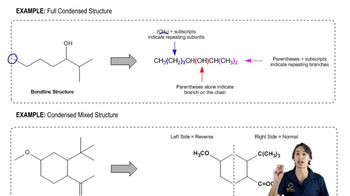
Condensed structural formulas provide a simplified way to represent the structure of a molecule, showing how atoms are connected without depicting all the bonds explicitly. This notation helps in visualizing the arrangement of atoms and can highlight functional groups or branching in organic compounds. Recognizing condensed formulas is essential for comparing different structures to identify isomers.
Stereochemistry is the study of the spatial arrangement of atoms in molecules and how this affects their chemical behavior. It includes concepts such as chirality and geometric isomerism, which can lead to compounds with the same connectivity but different three-dimensional shapes. Understanding stereochemistry is important when analyzing whether different structures represent the same compound, especially in cases where spatial arrangement influences properties.