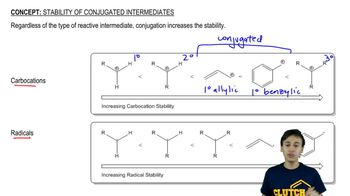
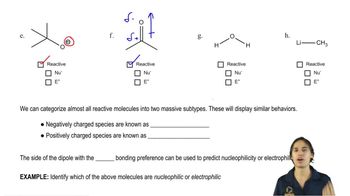
For each set of reactive intermediates, rank them in order of reactivity (1 = most reactive). (c)
Verified step by step guidance
1
Step 1: Identify the reactive intermediates shown in the image. The intermediates are: (1) a carbocation (CH2=CH+), (2) an acyl cation (CH3CO+), (3) a primary carbocation (CH3CH2+), (4) a tertiary carbocation ((CH3)3C+), and (5) a carbanion (CH3−).
Step 2: Understand the factors that influence reactivity. For carbocations, stability is determined by resonance stabilization and hyperconjugation. For carbanions, stability is influenced by the electronegativity of the atom bearing the negative charge and the ability to delocalize the charge.
Step 3: Analyze the stability of each intermediate. (1) CH2=CH+ is stabilized by resonance due to the adjacent double bond. (2) CH3CO+ is highly stabilized by resonance with the oxygen atom. (3) CH3CH2+ is a primary carbocation, which is less stable due to lack of resonance or hyperconjugation. (4) (CH3)3C+ is a tertiary carbocation, which is stabilized by hyperconjugation from three methyl groups. (5) CH3− is a carbanion, which is highly reactive due to the negative charge on a carbon atom.
Step 4: Rank the intermediates based on their reactivity. The most reactive species will be the least stable, and the least reactive species will be the most stable. Consider resonance and hyperconjugation effects for carbocations and the destabilizing effect of the negative charge for the carbanion.
Step 5: Conclude the ranking order based on the analysis. The acyl cation (CH3CO+) is the most stable due to resonance with oxygen, followed by the allylic carbocation (CH2=CH+), the tertiary carbocation ((CH3)3C+), the primary carbocation (CH3CH2+), and finally the carbanion (CH3−), which is the least stable and most reactive.
Verified video answer for a similar problem:
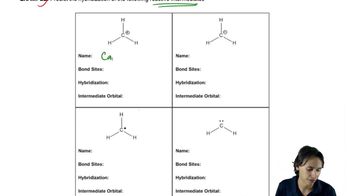
This video solution was recommended by our tutors as helpful for the problem above
Play a video:
Was this helpful?
Key Concepts
Here are the essential concepts you must grasp in order to answer the question correctly.
Reactive Intermediates
Reactive intermediates are transient species that form during the course of a chemical reaction. They include carbocations, carbanions, and free radicals, each with distinct stability and reactivity. Understanding the nature of these intermediates is crucial, as their stability directly influences the rate and pathway of the reaction.
The stability of reactive intermediates is determined by factors such as hybridization, resonance, and inductive effects. For example, tertiary carbocations are more stable than primary ones due to greater hyperconjugation and inductive effects from surrounding alkyl groups. This stability ranking is essential for predicting the reactivity of intermediates.
Reactivity trends in organic chemistry often follow the principle that less stable intermediates are more reactive. For instance, a highly unstable free radical will react more readily than a stable one. Recognizing these trends allows chemists to predict the outcome of reactions and rank intermediates based on their expected reactivity.