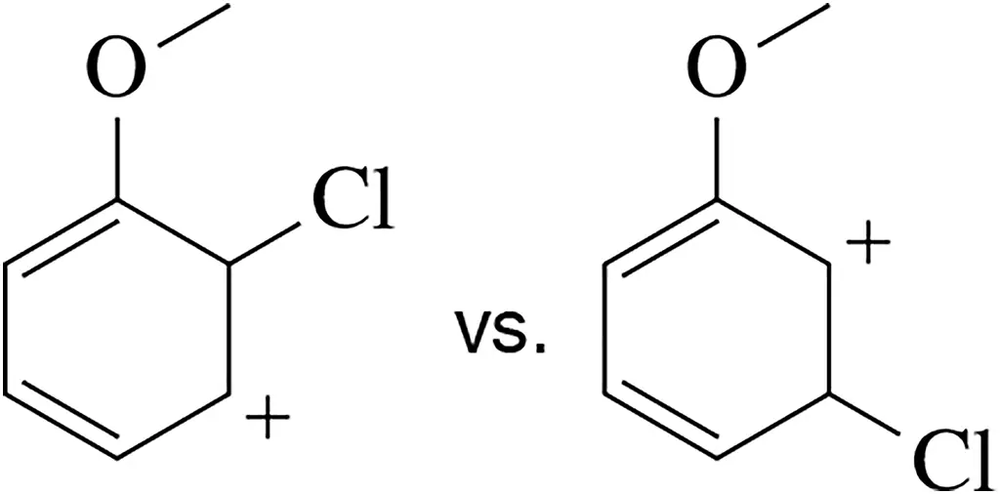
Draw resonance structures to identify which of the following is the more stable carbocation.
Verified step by step guidance
1
Step 1: Understand the concept of resonance. Resonance structures are alternative Lewis structures for a molecule or ion that differ only in the placement of electrons, not the arrangement of atoms. Resonance helps to delocalize charge, increasing stability.
Step 2: Identify the carbocations in the problem. A carbocation is a positively charged carbon atom with only three bonds, leaving it electron-deficient. Stability of carbocations is influenced by resonance and hyperconjugation.
Step 3: Draw the resonance structures for each carbocation. Begin by moving electrons (such as π electrons or lone pairs) to adjacent atoms to create alternative structures. Ensure that the positive charge is delocalized across the molecule in each resonance structure.
Step 4: Evaluate the resonance structures. The more resonance structures a carbocation has, and the more delocalized the positive charge is, the more stable the carbocation. Additionally, check if the resonance structures place the positive charge on more electronegative atoms or in aromatic systems, which further increases stability.
Step 5: Compare the stability of the two carbocations based on their resonance structures. The carbocation with more resonance structures and better charge delocalization will be the more stable one.
Verified video answer for a similar problem:
This video solution was recommended by our tutors as helpful for the problem above
Video duration:
2m
Play a video:
Was this helpful?
Key Concepts
Here are the essential concepts you must grasp in order to answer the question correctly.
Carbocation Stability
Carbocations are positively charged carbon species that can vary in stability based on their structure. Stability increases with the degree of substitution; tertiary carbocations are more stable than secondary, which are more stable than primary. This is due to hyperconjugation and the inductive effect from surrounding alkyl groups that help to disperse the positive charge.
Resonance structures are different ways of drawing the same molecule that illustrate the delocalization of electrons. In the context of carbocations, resonance can stabilize the positive charge by allowing it to be shared across multiple atoms. The more resonance structures a carbocation has, the more stable it is, as the charge is less localized.
Electrophilic stability refers to the ability of a carbocation to stabilize its positive charge through various mechanisms, including resonance and inductive effects. A more stable carbocation will be less reactive and more favorable in chemical reactions. Understanding the factors that contribute to electrophilic stability is crucial for predicting the behavior of carbocations in organic reactions.