What reagents should be used to carry out the following syntheses?
Verified step by step guidance
1
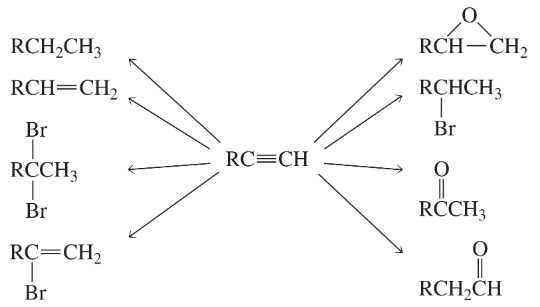
To convert an alkyne (RC≡CH) to an alkane (RCH₂CH₃), use hydrogen gas (H₂) with a palladium catalyst (Pd/C) for complete hydrogenation.
To convert an alkyne (RC≡CH) to an alkene (RCH=CH₂), use hydrogen gas (H₂) with a Lindlar's catalyst to achieve syn-addition and stop at the alkene stage.
To convert an alkyne (RC≡CH) to a bromoalkene (RCH=CHBr), use hydrogen bromide (HBr) in the presence of a peroxide to achieve anti-Markovnikov addition.
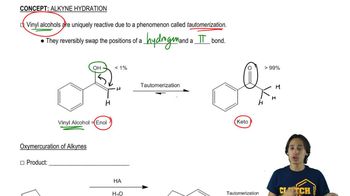
To convert an alkyne (RC≡CH) to a ketone (RCCH₃), use water (H₂O) with a mercury(II) sulfate (HgSO₄) catalyst in an acidic medium (H₂SO₄) for hydration via Markovnikov addition.
To convert an alkyne (RC≡CH) to an aldehyde (RCH₂CHO), use hydroboration-oxidation with reagents such as disiamylborane followed by hydrogen peroxide (H₂O₂) and sodium hydroxide (NaOH) for anti-Markovnikov addition.
Verified video answer for a similar problem:
This video solution was recommended by our tutors as helpful for the problem above
Video duration:
2m
Play a video:
Was this helpful?
Key Concepts
Here are the essential concepts you must grasp in order to answer the question correctly.
Alkyne Reactivity
Alkynes, characterized by a carbon-carbon triple bond, exhibit unique reactivity patterns. They can undergo various reactions such as hydrogenation, halogenation, and hydration. Understanding these reactions is crucial for predicting the products formed when specific reagents are applied to alkynes in synthetic pathways.
Electrophilic addition reactions involve the addition of electrophiles to nucleophilic sites in unsaturated hydrocarbons like alkenes and alkynes. In the context of the question, recognizing how reagents such as bromine or water can add across the triple bond of an alkyne is essential for determining the correct synthetic route and products.
Functional group transformations refer to the chemical reactions that convert one functional group into another. In organic synthesis, this concept is vital for understanding how to manipulate starting materials to achieve desired products, such as converting alkynes into alcohols or carbonyl compounds through specific reagents and reaction conditions.