Rank each set of compounds in order of increasing boiling points. (a) triethylamine, di-n-propylamine, n-propyl ether (b) ethanol, dimethylamine, dimethyl ether (c) diethylamine, diisopropylamine, trimethylamine
Verified step by step guidance
1
Step 1: Understand the factors affecting boiling points. Boiling points are influenced by intermolecular forces such as hydrogen bonding, dipole-dipole interactions, and London dispersion forces. Compounds with stronger intermolecular forces generally have higher boiling points.
Step 2: Analyze the functional groups in each compound. For example, amines can form hydrogen bonds due to the presence of an N-H bond, ethers rely on dipole-dipole interactions, and alcohols can form strong hydrogen bonds due to the O-H bond.
Step 3: Consider molecular size and branching. Larger molecules with more surface area tend to have stronger London dispersion forces, leading to higher boiling points. Branching reduces surface area and weakens dispersion forces, lowering boiling points.
Step 4: Compare the compounds in each set based on their ability to form hydrogen bonds, molecular size, and branching. For example: (a) triethylamine has no N-H bond for hydrogen bonding, di-n-propylamine has N-H bonds and is less branched, and n-propyl ether relies on dipole-dipole interactions. (b) Ethanol has strong hydrogen bonding due to the O-H group, dimethylamine has weaker hydrogen bonding due to the N-H group, and dimethyl ether relies on dipole-dipole interactions. (c) Diethylamine has N-H bonds for hydrogen bonding, diisopropylamine is more branched, and trimethylamine lacks N-H bonds.
Step 5: Rank the compounds in each set in order of increasing boiling points based on the analysis. For example, prioritize compounds with stronger hydrogen bonding, larger molecular size, and less branching for higher boiling points.
Verified video answer for a similar problem:
This video solution was recommended by our tutors as helpful for the problem above
Video duration:
6m
Play a video:
Was this helpful?
Key Concepts
Here are the essential concepts you must grasp in order to answer the question correctly.
Boiling Point and Intermolecular Forces
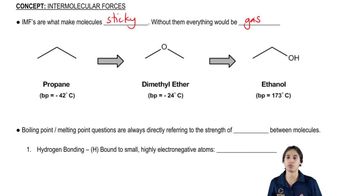
The boiling point of a compound is influenced by the strength of its intermolecular forces. Compounds with stronger forces, such as hydrogen bonding or dipole-dipole interactions, typically have higher boiling points. For example, alcohols like ethanol can form hydrogen bonds, leading to higher boiling points compared to ethers or amines that may have weaker interactions.
How IMFs are related to melting and boiling points.
Hydrogen Bonding
Hydrogen bonding occurs when a hydrogen atom covalently bonded to a highly electronegative atom (like oxygen or nitrogen) interacts with another electronegative atom. This type of bonding significantly increases the boiling point of compounds. For instance, ethanol can form hydrogen bonds, while ethers and amines may not exhibit the same extent of hydrogen bonding, affecting their boiling points.
The molecular structure and size of a compound also play a crucial role in determining its boiling point. Larger molecules generally have higher boiling points due to increased van der Waals forces. Additionally, branching in aliphatic amines can reduce boiling points compared to their straight-chain counterparts, as branching decreases surface area and thus the strength of intermolecular interactions.