Which stereoisomer of 3-hexene forms (3S,4S)-4-bromo-3-hexanol and (3R,4R)-4-bromo-3-hexanol when it reacts with Br2 and H2O?
Verified step by step guidance
1
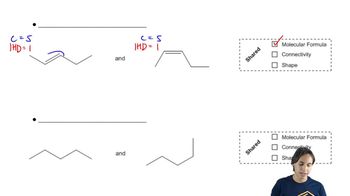
Identify the structure of 3-hexene. It is a six-carbon alkene with a double bond between carbons 3 and 4. The stereoisomers of 3-hexene are the cis (Z) and trans (E) forms. These differ in the spatial arrangement of the substituents around the double bond.
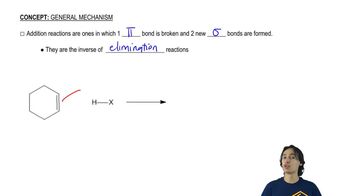
Understand the reaction mechanism. When 3-hexene reacts with Br2 and H2O, it undergoes a halohydrin formation reaction. In this reaction, the bromine molecule (Br2) adds across the double bond, and water acts as a nucleophile to form a bromohydrin.
Analyze the stereochemical outcome. The addition of Br2 to the double bond occurs via an anti-addition mechanism, meaning the bromine and hydroxyl groups will add to opposite faces of the double bond. This anti-addition leads to the formation of enantiomers.
Determine which stereoisomer of 3-hexene leads to the specified products. The (3S,4S)-4-bromo-3-hexanol and (3R,4R)-4-bromo-3-hexanol are enantiomers, which means they are formed from the cis (Z) isomer of 3-hexene. The cis isomer allows for the anti-addition to produce these specific stereochemical configurations.
Conclude that the cis (Z) stereoisomer of 3-hexene is the one that forms (3S,4S)-4-bromo-3-hexanol and (3R,4R)-4-bromo-3-hexanol when it reacts with Br2 and H2O.
Verified video answer for a similar problem:
This video solution was recommended by our tutors as helpful for the problem above
Video duration:
8m
Play a video:
0 Comments
Key Concepts
Here are the essential concepts you must grasp in order to answer the question correctly.
Stereoisomerism
Stereoisomerism refers to the phenomenon where compounds have the same molecular formula and connectivity of atoms but differ in the spatial arrangement of their atoms. This can lead to different physical and chemical properties. In the case of alkenes like 3-hexene, stereoisomers can exist as cis or trans forms, which are crucial for determining the outcome of reactions involving stereospecificity.
Electrophilic addition reactions are a type of reaction where an electrophile reacts with a nucleophile, typically involving alkenes. In the context of 3-hexene reacting with Br2 and H2O, the double bond acts as a nucleophile, attacking the electrophilic bromine, leading to the formation of bromohydrins. Understanding this mechanism is essential for predicting the stereochemical outcomes of the reaction.
Stereochemistry involves the study of the spatial arrangement of atoms in molecules and how this affects their chemical behavior. In the reaction of 3-hexene with Br2 and H2O, the stereochemistry of the resulting products, (3S,4S)-4-bromo-3-hexanol and (3R,4R)-4-bromo-3-hexanol, is determined by the mechanism of the addition reaction and the configuration of the starting alkene. This concept is vital for predicting which stereoisomer will be formed.