
Predict the major product(s) for each reaction. Include stereochemistry where appropriate. a. 1-methylcyclohexene + Cl2/H2O b. 2-methylbut-2-ene + Br2/H2O
Verified step by step guidance
1
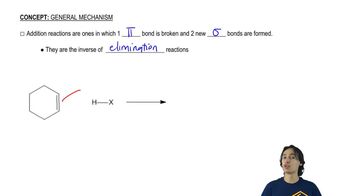
Step 1: Analyze the reaction conditions for part (a). The reagents Cl2/H2O indicate a halohydrin formation reaction. This involves the addition of a halogen (Cl2) and water (H2O) to an alkene, resulting in a halohydrin product. The reaction proceeds via an electrophilic addition mechanism.
Step 2: For part (a), identify the alkene in 1-methylcyclohexene. The double bond is located between the methyl group and the cyclohexane ring. The first step involves the formation of a cyclic chloronium ion intermediate as Cl2 reacts with the double bond.
Step 3: In part (a), water (H2O) acts as a nucleophile and attacks the more substituted carbon of the chloronium ion intermediate, leading to regioselectivity. This results in the formation of a halohydrin where the hydroxyl group (-OH) is added to the more substituted carbon and the chlorine atom (Cl) is added to the less substituted carbon. Consider stereochemistry: the addition is anti, meaning the -OH and Cl groups will be on opposite faces of the ring.
Step 4: Analyze the reaction conditions for part (b). The reagents Br2/H2O also indicate a halohydrin formation reaction. The alkene in 2-methylbut-2-ene is symmetrical, with the double bond between the second and third carbons. The reaction proceeds similarly to part (a), forming a cyclic bromonium ion intermediate.
Step 5: For part (b), water (H2O) attacks the more substituted carbon of the bromonium ion intermediate, leading to regioselectivity. The hydroxyl group (-OH) is added to the more substituted carbon, and the bromine atom (Br) is added to the less substituted carbon. The addition is anti, meaning the -OH and Br groups will be on opposite sides of the molecule. Consider stereochemistry in the final product.
Verified video answer for a similar problem:
This video solution was recommended by our tutors as helpful for the problem above
Video duration:
9m
Play a video:
0 Comments
Key Concepts
Here are the essential concepts you must grasp in order to answer the question correctly.
Electrophilic Addition Reactions
Electrophilic addition reactions involve the addition of electrophiles to alkenes, where the double bond acts as a nucleophile. In the presence of halogens like Cl2 or Br2, the alkene reacts to form a cyclic halonium ion intermediate, which can lead to the formation of various products depending on the conditions and the presence of nucleophiles like water.
Stereochemistry refers to the spatial arrangement of atoms in molecules and how this affects their chemical behavior. In reactions involving alkenes and halogens, the formation of stereoisomers can occur, particularly when the addition of the halogen and nucleophile leads to chiral centers. Understanding stereochemistry is crucial for predicting the major products and their configurations.
Markovnikov's Rule states that in the addition of HX to an alkene, the hydrogen atom will attach to the carbon with the greater number of hydrogen atoms already attached. This principle helps predict the regioselectivity of the reaction, guiding the formation of the more stable carbocation intermediate and ultimately influencing the major product formed in reactions with water as a nucleophile.