Simple aminoacetals hydrolyze quickly and easily in dilute acid. Propose a mechanism for hydrolysis of the following aminoacetal:
Verified step by step guidance
1
Step 1: Protonation of the oxygen atom in the aminoacetal by the hydronium ion (H₃O⁺). This increases the electrophilicity of the carbon atom attached to the oxygen, making it more susceptible to nucleophilic attack.
Step 2: Cleavage of the C-O bond occurs, leading to the formation of a hemiaminal intermediate. The dimethylamino group (N(CH₃)₂) is still attached to the molecule at this stage.
Step 3: Protonation of the nitrogen atom in the dimethylamino group occurs, making it a better leaving group. This step is facilitated by the acidic environment.
Step 4: The dimethylamino group (N(CH₃)₂) leaves as dimethylammonium ion ((CH₃)₂NH₂⁺), resulting in the formation of an oxonium ion intermediate.
Step 5: Deprotonation of the oxonium ion occurs, leading to the formation of the final products: a cyclic ketone (with an OH group) and dimethylammonium ion ((CH₃)₂NH₂⁺).
Verified video answer for a similar problem:
This video solution was recommended by our tutors as helpful for the problem above
Video duration:
9m
Play a video:
Was this helpful?
Key Concepts
Here are the essential concepts you must grasp in order to answer the question correctly.
Aminoacetals
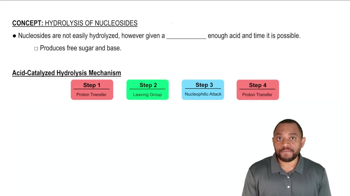
Aminoacetals are compounds formed from the reaction of an amine with an aldehyde or ketone, resulting in a structure that contains both an amine and an acetal functional group. They are characterized by their ability to undergo hydrolysis, particularly in acidic conditions, leading to the regeneration of the original aldehyde or ketone and the corresponding amine.
Hydrolysis Mechanism
The hydrolysis mechanism of aminoacetals typically involves protonation of the acetal oxygen by an acid, which increases the electrophilicity of the carbon atom bonded to the acetal oxygen. This step is followed by the nucleophilic attack of water, leading to the cleavage of the acetal bond and the formation of the corresponding aldehyde and amine. Understanding this mechanism is crucial for predicting the products of the reaction.
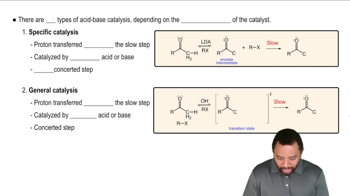
Acid-base catalysis plays a significant role in the hydrolysis of aminoacetals. In this context, the presence of an acid facilitates the protonation of the acetal oxygen, enhancing the reaction rate. This concept is fundamental in organic chemistry as it illustrates how acids can lower the activation energy of a reaction, thereby accelerating the hydrolysis process and influencing the reaction pathway.