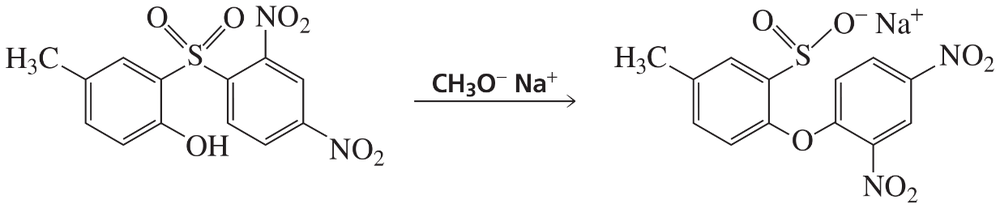
Propose a mechanism for each of the following reactions: b.
Verified step by step guidance
1
Step 1: Analyze the reactants and products. The starting material contains a hydroxyl group (-OH) and a sulfone group (-SO2) attached to a benzene ring. The product shows the formation of an ether bond (-O-) between two aromatic rings, with the sulfone group now bearing a negative charge.
Step 2: Recognize the role of the reagent, NaOCH3. Sodium methoxide (NaOCH3) is a strong base and can deprotonate the hydroxyl group (-OH) on the benzene ring, forming a phenoxide ion (-O⁻). This phenoxide ion is highly nucleophilic.
Step 3: Propose the nucleophilic attack mechanism. The phenoxide ion generated in Step 2 can attack the electrophilic sulfone group (-SO2) on the adjacent benzene ring. This results in the formation of a new ether bond (-O-) between the two aromatic rings.
Step 4: Account for the charge distribution. After the nucleophilic attack, the sulfone group (-SO2) loses one of its oxygen atoms to form a negatively charged sulfonate group (-SO2⁻). This charge is stabilized by resonance within the sulfonate group.
Step 5: Verify the mechanism consistency. Ensure that the proposed mechanism aligns with the observed product structure, including the ether bond formation and the sulfonate group (-SO2⁻) in the final product.
Verified video answer for a similar problem:
This video solution was recommended by our tutors as helpful for the problem above
Video duration:
5m
Play a video:
Was this helpful?
Key Concepts
Here are the essential concepts you must grasp in order to answer the question correctly.
Williamson Ether Synthesis
Williamson Ether Synthesis is a method for producing ethers through the reaction of an alkoxide ion with a primary alkyl halide. In this reaction, the alkoxide acts as a nucleophile, attacking the electrophilic carbon of the alkyl halide, leading to the formation of an ether. This reaction is particularly effective with primary halides to avoid elimination reactions.
Nucleophilic substitution is a fundamental reaction mechanism in organic chemistry where a nucleophile replaces a leaving group in a molecule. This can occur via two main pathways: SN1, which involves a two-step mechanism with a carbocation intermediate, and SN2, which is a one-step process where the nucleophile attacks the substrate simultaneously as the leaving group departs. The choice of mechanism depends on the structure of the substrate and the conditions of the reaction.
Nucleophiles and Electrophiles can react in Substitution Reactions.
Alkoxide Ion
An alkoxide ion is a deprotonated alcohol, represented as R-O⁻, where R is an alkyl group. Alkoxides are strong nucleophiles and are commonly used in organic synthesis, particularly in reactions like Williamson Ether Synthesis. They can be generated by treating alcohols with strong bases, such as sodium hydride or sodium metal, making them highly reactive in forming new carbon-oxygen bonds.