1,4-Diazabicyclo[2.2.2]octane (abbreviated DABCO) is a tertiary amine that catalyzes transesterification reactions. Explain how it does this.
Verified step by step guidance
1
Step 1: Recognize that DABCO is a tertiary amine (NR3) and acts as a nucleophilic catalyst in transesterification reactions. Its structure contains two nitrogen atoms, both of which are basic and can interact with electrophilic species.
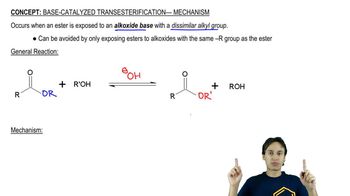
Step 2: In a transesterification reaction, the ester group (RCOOR) reacts with an alcohol (R'OH) to form a new ester (RCOOR') and release the original alcohol (ROH). DABCO facilitates this process by activating the ester group.
Step 3: DABCO's nitrogen atoms can donate lone pairs of electrons to the carbonyl carbon of the ester group, increasing the electrophilicity of the carbonyl carbon. This makes it more susceptible to nucleophilic attack by the incoming alcohol (R'OH).
Step 4: Once the alcohol (R'OH) attacks the activated carbonyl carbon, a tetrahedral intermediate is formed. DABCO stabilizes this intermediate by interacting with the leaving group (RO-) and facilitating its departure.
Step 5: The reaction proceeds to completion, forming the new ester (RCOOR') and releasing the original alcohol (ROH). DABCO is regenerated at the end of the reaction, allowing it to catalyze further transesterification reactions.
Verified video answer for a similar problem:
This video solution was recommended by our tutors as helpful for the problem above
Video duration:
4m
Play a video:
Was this helpful?
Key Concepts
Here are the essential concepts you must grasp in order to answer the question correctly.
Transesterification
Transesterification is a chemical reaction where an ester is converted into another ester through the exchange of the alkoxy group. This process typically involves the reaction of an alcohol with an ester, resulting in the formation of a new ester and a different alcohol. It is commonly catalyzed by acids or bases, and in this case, DABCO acts as a catalyst to facilitate the reaction by stabilizing the transition state.
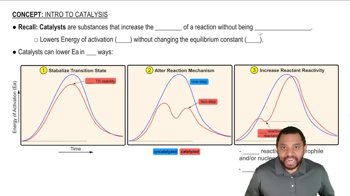
Catalysts are substances that increase the rate of a chemical reaction without being consumed in the process. They work by lowering the activation energy required for the reaction to proceed. In the context of transesterification, DABCO, as a tertiary amine, provides a basic environment that enhances the nucleophilicity of the alcohol, allowing for a more efficient reaction with the ester.
DABCO functions as a nucleophilic catalyst in transesterification by forming a temporary bond with the alcohol, which increases its reactivity. The nitrogen atom in DABCO can donate a lone pair of electrons to the carbonyl carbon of the ester, facilitating the nucleophilic attack by the alcohol. This mechanism not only accelerates the reaction but also helps in stabilizing the transition state, leading to a more favorable reaction pathway.