a. Draw resonance contributors to show why pyridine-N-oxide is more reactive than pyridine toward electrophilic aromatic substitution.
Verified step by step guidance
1
Identify the structure of pyridine-N-oxide. Pyridine-N-oxide is a pyridine ring with an oxygen atom bonded to the nitrogen via a coordinate covalent bond, giving the nitrogen a positive formal charge and the oxygen a negative formal charge.
Recall the concept of resonance. Resonance contributors are alternative Lewis structures that show the delocalization of electrons within a molecule. For pyridine-N-oxide, the negative charge on the oxygen can delocalize into the aromatic ring, enhancing electron density at certain positions.
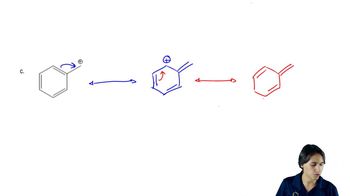
Draw the resonance contributors for pyridine-N-oxide. Start by moving a lone pair of electrons from the negatively charged oxygen into the N-O bond, which pushes the π-electrons in the ring to different positions. This creates resonance structures where the negative charge is delocalized onto the carbon atoms in the ring.
Compare the resonance contributors of pyridine-N-oxide to those of pyridine. In pyridine, the nitrogen atom does not have a formal positive charge, and the electron density in the ring is lower. In contrast, the resonance contributors of pyridine-N-oxide show increased electron density at specific positions in the ring, making it more reactive toward electrophilic aromatic substitution.
Conclude that the increased electron density in pyridine-N-oxide, as shown by its resonance contributors, makes it more nucleophilic and thus more reactive toward electrophilic aromatic substitution compared to pyridine.
Verified video answer for a similar problem:
This video solution was recommended by our tutors as helpful for the problem above
Video duration:
8m
Play a video:
Was this helpful?
Key Concepts
Here are the essential concepts you must grasp in order to answer the question correctly.
Resonance Structures
Resonance structures are different ways of drawing the same molecule that illustrate the delocalization of electrons. In the case of pyridine-N-oxide, resonance contributors can show how the presence of the N-oxide group affects electron density distribution, making certain positions on the aromatic ring more reactive toward electrophiles.
Electrophilic aromatic substitution is a fundamental reaction in organic chemistry where an electrophile replaces a hydrogen atom on an aromatic ring. The reactivity of the aromatic compound is influenced by the electron-donating or withdrawing effects of substituents, which can stabilize or destabilize the intermediate formed during the reaction.
Electron-withdrawing groups (EWGs) are substituents that pull electron density away from the aromatic ring, often increasing the reactivity of the ring toward electrophiles. In pyridine-N-oxide, the oxygen atom of the N-oxide group acts as an EWG, enhancing the electrophilic attack at the ortho and para positions compared to unsubstituted pyridine.