For each of the following carbonyl addition reactions, would you expect a racemic mixture or a mixture enriched in one stereoisomer? In each case, draw both possible stereoisomeric products. (a)
Verified step by step guidance
1
Identify the type of reaction: The image shows a Grignard reaction, where a Grignard reagent (ethyl magnesium bromide) is added to a ketone (butanone) followed by an acid quench.
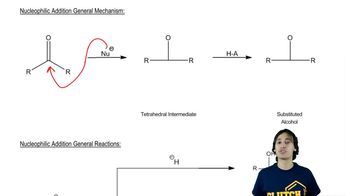
Understand the mechanism: The Grignard reagent acts as a nucleophile, attacking the electrophilic carbonyl carbon of the ketone, forming a tetrahedral intermediate.
Consider stereochemistry: The attack of the Grignard reagent on the planar carbonyl group can occur from either side, leading to the formation of two possible stereoisomers.
Draw the products: The reaction will produce two stereoisomers, which are enantiomers. Draw both possible configurations of the newly formed chiral center.
Determine the mixture type: Since the attack can occur from either side with equal probability, a racemic mixture of the two enantiomers is expected.
Verified video answer for a similar problem:
This video solution was recommended by our tutors as helpful for the problem above
Play a video:
Was this helpful?
Key Concepts
Here are the essential concepts you must grasp in order to answer the question correctly.
Carbonyl Chemistry
Carbonyl compounds, characterized by a carbon-oxygen double bond (C=O), are key functional groups in organic chemistry. They can undergo various reactions, including nucleophilic addition, where a nucleophile attacks the electrophilic carbon atom. Understanding the reactivity and properties of carbonyls is essential for predicting the outcomes of addition reactions.
Stereochemistry involves the study of the spatial arrangement of atoms in molecules and how this affects their chemical behavior. In carbonyl addition reactions, the formation of chiral centers can lead to the creation of stereoisomers. Recognizing whether a reaction produces a racemic mixture or isomerically enriched products is crucial for understanding the stereochemical outcome.
The nucleophilic addition mechanism describes how a nucleophile attacks the electrophilic carbon of a carbonyl compound, leading to the formation of an alkoxide intermediate. Depending on the symmetry of the carbonyl and the nature of the nucleophile, this process can yield either a racemic mixture of products or a predominant stereoisomer. Analyzing the mechanism helps predict the stereochemical results of the reaction.