Predict the products obtained when D-galactose reacts with each reagent. (j) (1) KCN/HCN; (2) H2, Pd/BaSO4; (3) H3O+
Verified step by step guidance
1
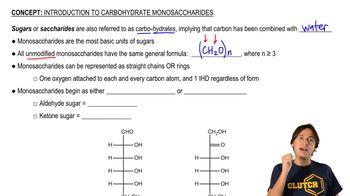
Step 1: Understand the structure of D-galactose. D-galactose is an aldohexose, meaning it contains six carbons and an aldehyde functional group at the first carbon. The reaction will primarily involve the aldehyde group.
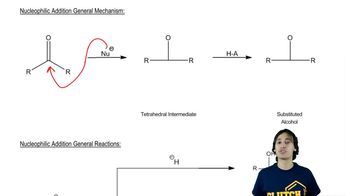
Step 2: Analyze the first reagent, KCN/HCN. This is a cyanohydrin formation reaction. The aldehyde group of D-galactose reacts with HCN to form a cyanohydrin. The cyanide ion (CN⁻) attacks the carbonyl carbon of the aldehyde, forming a new carbon-carbon bond and resulting in a hydroxyl group (-OH) at the former carbonyl carbon.
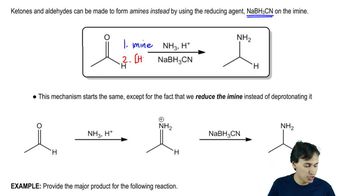
Step 3: Examine the second reagent, H₂ with Pd/BaSO₄. This is a partial reduction step. The nitrile group (-C≡N) formed in the previous step is reduced to an imine (-C=NH) under these conditions. The BaSO₄ acts as a poison to prevent over-reduction.
Step 4: Consider the third reagent, H₃O⁺. The imine group formed in the previous step undergoes hydrolysis in the presence of acid (H₃O⁺), converting it into a primary amine (-NH₂) and a carboxylic acid (-COOH) group. This results in the formation of an amino acid derivative.
Step 5: Summarize the overall transformation. The reaction sequence converts the aldehyde group of D-galactose into a cyanohydrin, then into an imine, and finally into an amino acid derivative with both an amine (-NH₂) and a carboxylic acid (-COOH) group at the former aldehyde carbon.
Verified video answer for a similar problem:
This video solution was recommended by our tutors as helpful for the problem above
Play a video:
Was this helpful?
Key Concepts
Here are the essential concepts you must grasp in order to answer the question correctly.
Monosaccharide Reactivity
Monosaccharides like d-galactose can undergo various chemical reactions due to their functional groups, primarily the aldehyde or ketone group. Understanding the reactivity of these groups is crucial for predicting the products of reactions with different reagents, such as nucleophiles or reducing agents.
In the presence of KCN or HCN, the nucleophilic cyanide ion can attack the carbonyl carbon of d-galactose, leading to the formation of cyanohydrin. This reaction exemplifies nucleophilic addition, where a nucleophile adds to a carbonyl compound, altering its structure and introducing new functional groups.
The reaction of d-galactose with H2 in the presence of a catalyst like Pd/BaSO4 represents a reduction process. This reaction typically converts the carbonyl group of the sugar into an alcohol, resulting in the formation of a sugar alcohol, which is an important transformation in organic chemistry.