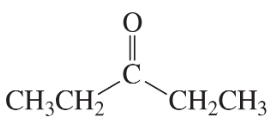
What aldol addition product is formed from each of the following compounds? b.
Verified step by step guidance
1
Step 1: Identify the compound provided in the image. The structure is cyclopentanone, a cyclic ketone with a five-membered ring and a carbonyl group.
Step 2: Recognize the reaction conditions. The presence of NaOH and H2O indicates that this is an aldol addition reaction, which involves the formation of a β-hydroxy ketone through the reaction of enolate ions with another molecule of the ketone.
Step 3: Generate the enolate ion. Under basic conditions (NaOH), the α-hydrogen of cyclopentanone is deprotonated to form the enolate ion. The enolate ion is resonance-stabilized and has nucleophilic properties.
Step 4: Perform the nucleophilic attack. The enolate ion attacks the carbonyl carbon of another cyclopentanone molecule, forming a new C-C bond. This step results in the formation of an intermediate alkoxide ion.
Step 5: Protonation of the alkoxide ion. The intermediate alkoxide ion is protonated by water (H2O), yielding the aldol addition product, which is a β-hydroxy ketone. The product will have a hydroxyl group on the β-carbon relative to the original carbonyl group.
Verified video answer for a similar problem:
This video solution was recommended by our tutors as helpful for the problem above
Video duration:
2m
Play a video:
Was this helpful?
Key Concepts
Here are the essential concepts you must grasp in order to answer the question correctly.
Aldol Addition
Aldol addition is a reaction between two carbonyl compounds, typically aldehydes or ketones, in the presence of a base, leading to the formation of β-hydroxy aldehydes or ketones. This reaction involves the nucleophilic attack of an enolate ion on another carbonyl carbon, resulting in a new carbon-carbon bond. The product can further undergo dehydration to form an α,β-unsaturated carbonyl compound.
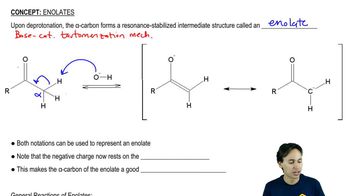
Enolate ions are formed when a carbonyl compound is deprotonated at the alpha carbon by a strong base, such as NaOH. This ion is resonance-stabilized, allowing it to act as a nucleophile in aldol reactions. The stability of the enolate ion is crucial, as it influences the reactivity and selectivity of the aldol addition process.
Aldol condensation is a subsequent reaction that occurs after aldol addition, where the β-hydroxy carbonyl compound loses a water molecule to form an α,β-unsaturated carbonyl compound. This dehydration step is often driven by the stability of the resulting conjugated system. The aldol condensation is significant in organic synthesis, as it allows for the formation of complex molecules with multiple functional groups.